 How Long Does It Really Take to Become a Yoga Teacher in Canada? (2026 Guide)
You love yoga. You’ve thought about teaching it. Now you want a straight answer to one question: how long will this actually take?
The honest answer is “it depends,” but not in a vague way. It depends on three concrete choices you make: the training format, the program length, and how fast you register once you’re done. This guide breaks down every stage of the process, using real timelines and costs from Canadian schools, so you can build a realistic plan instead of guessing.
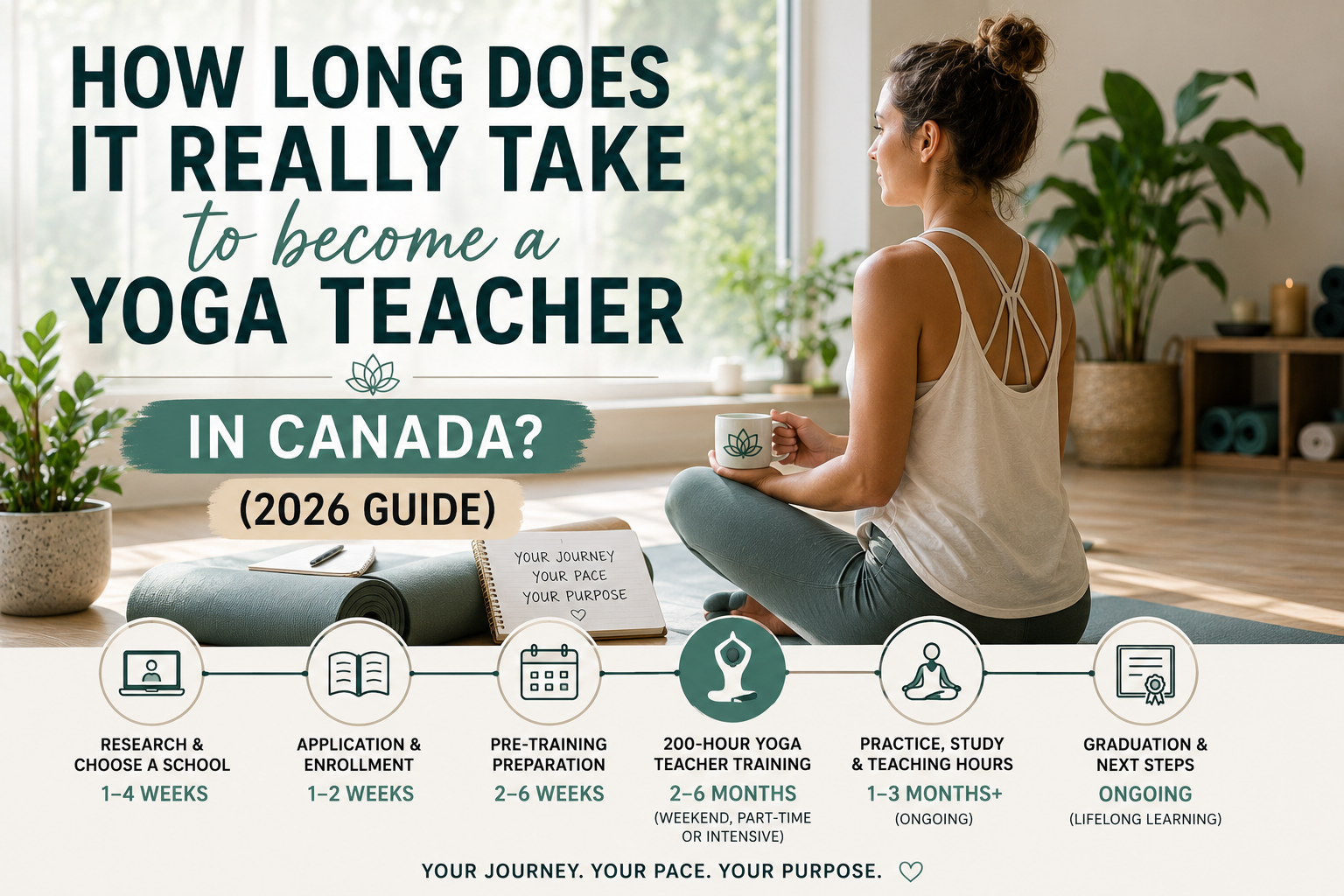
The Short Answer: Timeline at a Glance
Most people become a certified yoga teacher in Canada in 2 to 12 months. That’s a wide range, so here’s why.
A 200-hour teacher training (YTT) is the standard entry point. Yoga Alliance requires a minimum of 200 training hours, but it doesn’t set a calendar length. Schools decide that themselves. Some compress the hours into a 3 to 4 week daily intensive. Others spread the same 200 hours across 8 to 12 weekends, which naturally stretches the timeline to two or three months. Some Canadian schools, like the Yoga Association of Alberta, run part-time programs over 9 to 12 months so students can train at their own pace alongside a full-time job.
Once training ends, registering with Yoga Alliance is fast. Most graduates are listed in the directory within one to two weeks of submitting their paperwork.
So the real timeline math looks like this: training length (4 weeks to 12 months) plus registration (about 1 to 2 weeks) plus any prerequisite practice time you need before you even start. For most working adults, 3 to 6 months from enrollment to certified teacher is a realistic middle ground.
What “Becoming a Yoga Teacher” Actually Means in Canada
Unlike being a doctor, lawyer, or electrician, “yoga teacher” isn’t a government-regulated title in Canada. There’s no provincial licensing board. Anyone can technically call themselves a yoga teacher. But in practice, studios, gyms, and insurance providers almost universally expect one specific credential: RYT-200, which stands for Registered Yoga Teacher, 200 hours.
This credential comes from Yoga Alliance, a U.S.-based nonprofit that sets training standards and maintains a global teacher registry. Yoga Alliance doesn’t run trainings itself. Instead, it accredits schools, called Registered Yoga Schools (RYS), that meet its curriculum requirements. When you complete a 200-hour program at an RYS-accredited school, you become eligible to register as an RYT-200.
The curriculum for these programs is fairly standardized. You’ll study asana (physical postures), pranayama (breathing techniques), meditation, anatomy and physiology, yoga philosophy, and teaching methodology. Programs also include a practicum, where you actually practice teaching and receive feedback. This structure is why the training takes real time, no matter the format. You can’t rush anatomy or skip practice teaching and still walk away prepared.
It’s worth noting that some Canadian organizations, such as the Yoga Association of Alberta, run their own certification tracks that are separately recognized while also holding Yoga Alliance registration. Either path gets you a credential that Canadian studios recognize, but RYT-200 remains the most widely requested designation nationally.
The Real Factor That Decides Your Timeline: Training Format
If there’s one decision that changes your timeline more than anything else, it’s the format of your training. Canadian schools generally offer three options.
Daily intensives run for 3 to 4 consecutive weeks, often 6 to 8 hours a day. You take time off work or clear your schedule completely. Programs like Modo Yoga’s Foundational Training in Mississauga run this way, packing all 200 hours into two intensive weeks of full-day immersion. The appeal is speed and depth. When yoga is the only thing you’re doing all day, learning compounds fast. The tradeoff is that you need to be able to step away from work, family, or other obligations for a full month.
Weekend or part-time programs spread training across 8 to 12 weekends, usually over 3 to 9 months. You keep your job and your regular life, attending sessions Friday evenings through Sunday. This is the most common format for working adults in Canadian cities. Programs at Toronto Yoga Co. and similar studios typically run 12 weeks this way. The extra time between sessions isn’t wasted, either. Spaced learning tends to help retention, giving you days to practice and integrate what you just studied before the next session.
Hybrid and online-supported programs combine self-paced online coursework with in-person or live-online teaching practice. Yoga Alliance permits blended learning, but it does not allow the entire 200 hours to be self-paced video content. Live interaction and in-person or live-video teaching practice must make up a real portion of the training. These programs often run 3 to 6 months and appeal to people balancing training with a demanding schedule.
Your lifestyle should drive this choice, not the other way around. A useful way to test this is to ask yourself one honest question: could I actually disappear from my normal routine for a full month, without resentment or burnout creeping in by week two? If the answer is yes, an intensive can be genuinely transformative. If the answer is no, forcing yourself into that format often backfires, since exhaustion and distraction undercut the depth the format is supposed to provide. There’s no version of “the right answer” here that applies to everyone. Some people thrive on total immersion. Others learn better in small, repeated doses over months. Both produce fully qualified teachers when the underlying curriculum is solid.
 Step-by-Step: The Full Timeline Breakdown
Here’s what the process looks like in sequence, with realistic time estimates for each stage.
Step 1: Build a consistent practice (0 to 6 months, if needed). Most programs don’t require a minimum number of years practicing yoga, but nearly all recommend or expect steady attendance beforehand, often several classes a week for at least a few months. If you’re already practicing 2 to 3 times weekly, you can likely skip this step. If you’re newer to yoga, budget 3 to 6 months to build comfort with basic postures before training starts. Trying to learn to teach a pose you can barely do yourself creates unnecessary stress.
Step 2: Choose and enroll in a program (2 to 6 weeks). Researching schools, comparing curriculums, and confirming a registered school’s accreditation on the Yoga Alliance school directory takes real time. Rushing this step is a common mistake; enrolling in a program that later turns out not to be properly registered can cost you the entire investment.
Step 3: Complete the 200-hour training (4 weeks to 12 months). This is the bulk of your timeline, and it’s entirely dependent on the format you picked in the previous section. Within this stage, expect a rough split of your hours across categories: a large portion goes to technique, training, and practice (the physical postures and how to refine them), a smaller portion to teaching methodology, another chunk to anatomy and physiology, a section on yoga philosophy and ethics, and finally the practicum itself, where you lead practice classes and receive direct feedback. Yoga Alliance requires trainees to log a minimum number of hours actually teaching as the lead instructor, not just observing or assisting, so budget mental energy for this part specifically. It’s usually the most nerve-wracking stretch of training and also the most useful.
Step 4: Register with Yoga Alliance (1 to 2 weeks). Once you graduate, your school submits your completion. You then apply for RYT-200 status. For most graduates, the entire registration process takes about one to two weeks, provided you apply promptly. Waiting months or years to register can slow things down, since schools sometimes need extra time to locate older records.
Step 5: Start teaching (immediate, with a ramp-up period). You’re legally and professionally qualified to teach the moment you’re registered. That said, most new teachers spend 3 to 6 months building confidence, often by assisting more experienced instructors or teaching smaller community classes before stepping into a full studio schedule.
Add it up, and a motivated student with an existing practice, enrolled in a weekend program, can go from first inquiry to certified, registered teacher in roughly 4 to 6 months.
What It Costs in Canada (Because Time and Money Are Linked)
Cost matters here because it directly shapes which timeline is realistic for you. Canadian 200-hour programs generally range from CAD 2,900 to CAD 4,800, depending on format, location, and whether meals or accommodations are included.
Weekend and hybrid programs in cities like Toronto and Vancouver commonly fall between CAD 3,000 and CAD 3,800. Intensive, full-immersion programs, particularly those including accommodation at a retreat-style venue, run higher, often CAD 3,800 to CAD 4,800. Registration with Yoga Alliance itself adds a modest $50 application fee plus $65 in annual dues, for roughly $115 total at initial registration.
There’s also a hidden cost worth planning for: lost income. If you choose a 3 to 4 week intensive and need to take unpaid leave, that lost paycheck can add hundreds or thousands of dollars to your real cost, even though it doesn’t show up on the program’s price tag. Weekend programs avoid this problem but stretch your commitment over several months instead. Neither approach is wrong. It’s simply a tradeoff between compressed time and compressed cost.
Many Canadian schools, including those registered with the Government of Canada as educational institutions, can issue T2202A tax certificates for eligible training hours, which may reduce your net cost through tax credits. It’s worth asking any program you’re considering whether they offer this.
There are a few other costs people often forget to plan for. If your practice isn’t yet frequent, you may need several months of regular classes beforehand to build the stamina training requires. Drop-in classes at roughly $20 each, taken three times a week for a few months, add up quickly, though an unlimited monthly membership is often cheaper if you’re attending that often. You’ll also want a few props of your own, a solid mat, blocks, and a strap, along with any required reading, usually a copy of the Yoga Sutras of Patanjali or a foundational anatomy text. None of these costs are large individually, but together they can add a few hundred dollars to your total investment. Building them into your budget upfront avoids surprises partway through training.
Beyond the 200 Hours: RYT-300, RYT-500, and E-RYT
The 200-hour credential is the entry point, not the ceiling. If you plan to teach long-term, it helps to understand what comes next, even if you’re not ready for it yet.
RYT-300 is an advanced training that builds on your 200-hour foundation, covering deeper philosophy, advanced sequencing, and specialized teaching skills. Combined, a 200-hour plus 300-hour training equals the 500-hour tier.
RYT-500 represents 500 total hours of accredited training, either through one combined program or a 200-hour plus a separate 300-hour add-on. Many advanced studios and premium class formats prefer RYT-500 teachers for lead roles.
E-RYT (Experienced Registered Yoga Teacher) status isn’t about additional coursework. It’s earned through teaching experience after certification. To reach E-RYT 200, Yoga Alliance requires 1,000 hours of teaching and at least two years since your initial RYT-200 registration. E-RYT 500 requires 2,000 teaching hours and four years of experience. These credentials matter if you eventually want to lead your own teacher trainings or mentor new instructors, since Yoga Alliance requires Lead Trainers of RYS-200 programs to hold E-RYT 500 status.
None of this affects your initial timeline to becoming a teacher. But it’s useful context: your 200-hour certificate is a real, complete credential on its own, not a partial one waiting to be finished.
Common Delays That Push Your Timeline Back
A few predictable issues stretch out timelines more than anything else.
Choosing an unaccredited program. Not every “yoga teacher training” is registered with Yoga Alliance. If you complete a course that isn’t RYS-accredited, you may finish your training but be unable to register as an RYT at all. Always verify a school’s status directly through Yoga Alliance before enrolling, not just by trusting the school’s own marketing.
Missing practicum or attendance requirements. Yoga Alliance standards require completing all training hours, assignments, and teaching practice. If you miss sessions in a weekend-format program, you may need to make them up in a later cohort, adding months to your timeline.
Delaying registration after graduation. Some graduates finish training and simply don’t register right away. Months or years later, tracking down transcripts and instructor sign-offs becomes harder. Registering within a few weeks of graduation avoids this entirely.
Underestimating the prerequisite practice period. Jumping into a 200-hour training with little to no personal practice is possible, but it often means struggling to keep pace with the physical and technical demands, which can extend how long it takes you to feel ready to actually teach, even after you’re certified on paper.
Trying to combine multiple partial trainings. Yoga Alliance standards are explicit that training hours toward RYT-200 must come from a single registered program at one school. Mixing hours from a weekend workshop here and an online course there, hoping they’ll add up, generally doesn’t work and can leave you short of the credential you thought you’d earned.
Planning around these five issues alone will keep most students on schedule.
 How to Choose the Right Program for Your Timeline
Matching a program to your life, rather than picking the first one you find, is what actually determines whether your timeline holds up.
Start by being honest about your schedule. If you can genuinely clear 3 to 4 weeks for an intensive, that route gets you certified fastest in calendar time, even though it demands more all at once. If you’re working full-time and can’t take extended leave, a weekend or hybrid format spread across several months is the more sustainable choice, even though it takes longer start to finish.
Next, confirm accreditation directly. Search the school on the Yoga Alliance Registered School directory before paying a deposit. A polished website doesn’t guarantee registration.
Then look at cohort size and mentorship structure. Smaller cohorts, generally 12 to 18 students, tend to offer more individual feedback during practice teaching, which can shorten the “confidence gap” between certification and your first real class.
Finally, ask about post-certification support. Programs that include mentorship, practicum placements, or business-of-yoga training tend to shorten the informal ramp-up period after graduation, since you’re not figuring out how to find your first teaching gig entirely on your own.
What Happens After Certification
Certification is the finish line for training, not for learning to teach well. Most new RYT-200 teachers spend their first few months assisting more experienced instructors, subbing occasional classes, or teaching smaller community and donation-based sessions. This isn’t a formal requirement. It’s simply how most teachers build the confidence and classroom instincts that a 200-hour program can introduce but can’t fully complete on its own.
From there, many teachers choose to specialize or advance. Some pursue RYT-300 to deepen their skills. Others pick up specialty credentials for prenatal, children’s, or trauma-informed yoga, depending on the population they want to serve. None of this changes the answer to the original question, though. You are a certified, hireable yoga teacher the moment you’re registered.
It also helps to know that Yoga Alliance registration isn’t a one-time event you can forget about. Maintaining active RYT-200 status requires ongoing continuing education, generally around 30 hours every three years, split between teaching hours and study. Building this into your long-term plan from day one, rather than scrambling near a renewal deadline, keeps your credential active without last-minute stress. Many teachers fold this requirement into workshops, mentorship sessions, or short specialty courses they’d likely take anyway as they grow their practice.
Conclusion: How Long Does It Really Take to Become a Yoga Teacher in Canada?
So, how long does it really take to become a yoga teacher in Canada? For most people, the honest range is 2 to 12 months, and the biggest variable isn’t talent or dedication. It’s the training format you choose. A 3 to 4 week intensive gets you certified fastest in calendar time but demands full-time availability. A weekend or hybrid program takes longer overall but fits around a working life. Either path leads to the same destination: an RYT-200 credential recognized by studios across Canada and internationally, plus a registration process that typically takes just one to two weeks once training ends.
The real takeaway is this: your timeline is a choice, not a fixed rule. Pick the format that matches your actual life, verify the school’s accreditation before you enroll, and register promptly once you graduate. Do that, and you’ll go from curious student to certified teacher on a timeline that’s both realistic and entirely in your control.