
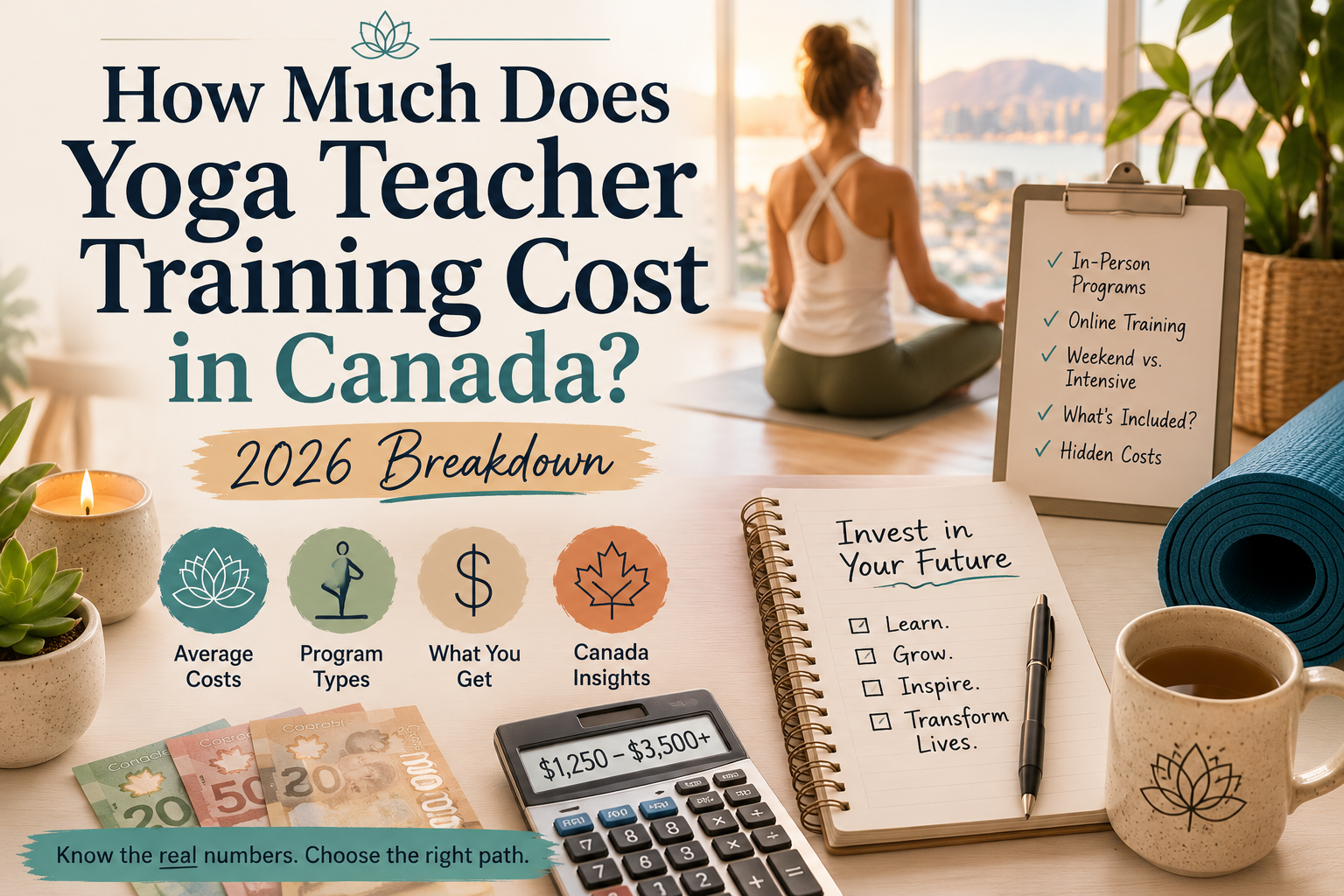
 How Much Does Yoga Teacher Training Cost in Canada? (2026 Breakdown)
If you’re searching for “How Much Does Yoga Teacher Training Cost in Canada? (2026 Breakdown)”, you’re probably standing at a real decision point. Maybe you’ve been practicing for years and want to teach. Maybe you just want to deepen your own practice. Either way, cost is one of the biggest factors in choosing a program.
The good news: Canadian yoga teacher training (YTT) prices are more transparent than ever. The range is wide, though. A 200-hour program can cost as little as $1,900 or as much as $5,000 or more. The difference usually comes down to location, format, and what’s included.
This guide breaks down real 2026 pricing from Canadian schools, explains what drives the cost up or down, and helps you budget for the full journey — not just tuition.
What’s Included in Yoga Teacher Training Costs
Tuition is the headline number, but it’s rarely the whole story. Before comparing schools, it helps to know what “cost” actually covers.
Most 200-hour programs include the core curriculum: asana (postures), teaching methodology, anatomy, philosophy, and a practicum where you teach real classes. Many Canadian schools now bundle in extras to sweeten the deal. For example, Pure Yoga Ottawa’s 200-hour program includes a 20-class card, on-demand video access, and a training manual alongside the certification itself.
Some costs sit outside tuition entirely. These include:
- A training manual or required textbooks
- Yoga Alliance registration (optional, but common)
- Props like mats, blocks, and straps
- Travel and accommodation, if the training is residential or held abroad
- Practicum requirements, such as attending extra classes to log observation hours
A few schools, like Modo Yoga’s Erin Mills training, build a pre-course e-module into the price. Others charge for that separately. Read the fine print before you compare two “$3,500” programs — they may not include the same things.
Knowing this upfront prevents budget surprises later. It also helps you ask better questions when you call or email a school directly.
Average Cost of a 200-Hour YTT in Canada (2026)
The 200-hour certification is the entry point for almost every yoga teacher in Canada. It’s also the most competitive part of the market, so pricing varies a lot by school and city.
Based on current 2026 listings, here’s what real Canadian programs charge:
- Power Yoga Canada lists its 200-hour Power Yoga Flow training at roughly $3,700.
- Pure Yoga Ottawa charges an early-bird rate of $3,250 plus HST, rising to $3,550 plus HST after September 1, 2026.
- Modo Yoga prices its Mississauga training at $4,400 CAD, including a 50-hour e-course.
- Yoga Sanctuary Academy in Toronto lists tuition at $5,000, with a $500 early-bird discount.
- The Yoga Association of Alberta runs a pay-as-you-go mentorship model, with weekend sessions at $190 each — about $1,900 for the full ten-weekend core, plus additional workshop costs.
That’s a spread of roughly $1,900 to $5,000 for the same 200-hour credential. The lower end typically means a longer timeline and a mentorship structure, rather than an intensive format. The higher end often includes more contact hours with lead teachers, smaller class sizes, or bundled extras like class passes and manuals.
There’s no single “right” price. A $2,000 program and a $5,000 program can both produce excellent teachers. The number matters less than what’s behind it.
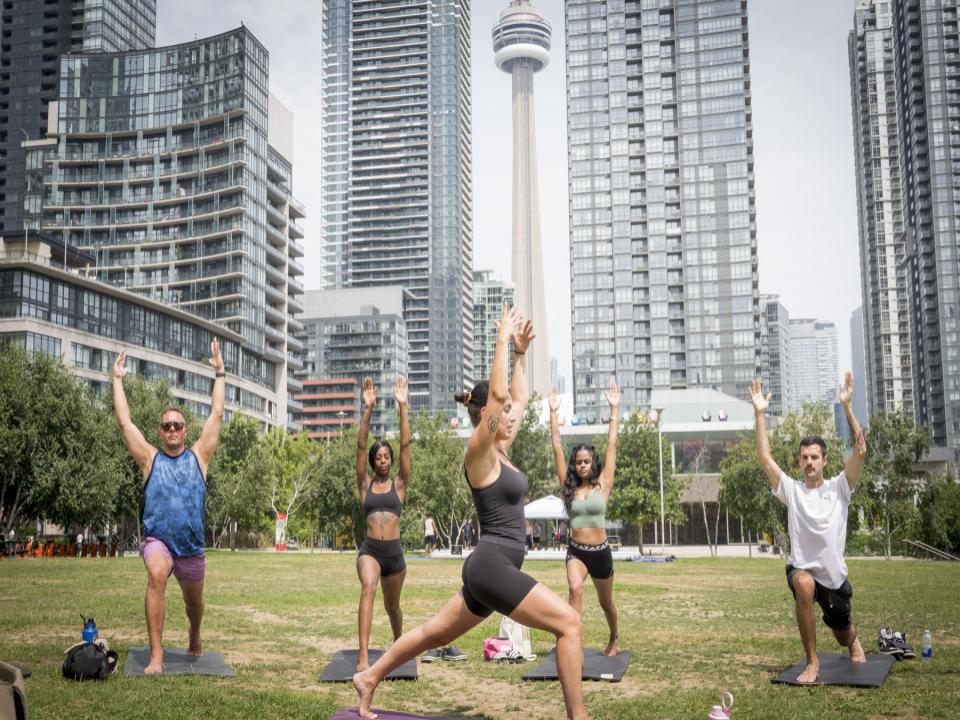 Cost by Region: Toronto, Montreal, Vancouver, and Beyond
Location affects price, but maybe not in the way you’d expect. Big cities don’t automatically mean bigger price tags — studio reputation and program structure matter more than geography.
In Ontario, prices cluster between $3,250 and $5,000 for 200-hour trainings, based on the Ottawa, Mississauga, and Toronto listings above. Ontario has the highest concentration of studios offering in-person YTT, so competition helps keep some prices moderate even in major cities.
In Quebec, Montreal-based studios like Luna Yoga Montreal run small cohorts — around 20 students per year — and offer tiered early-bird pricing, with up to $500 off tuition for people who register and pay well ahead of the start date. Smaller cohort sizes tend to push per-student costs slightly higher, but they also mean more individual feedback.
In Alberta, the Yoga Association of Alberta’s mentorship-based model is one of the most affordable structured paths in the country, since students pay per weekend rather than one lump sum.
British Columbia doesn’t have a single dominant price point; costs there tend to mirror Ontario’s range, with variation based on studio size and instructor experience.
The takeaway: don’t assume a program in a smaller city will be cheaper, or that a big-city studio will be expensive. Compare actual curricula and inclusions, not just postal codes.
In-Studio vs. Online vs. Hybrid Training Costs
Format changes both the price and the experience. Canada now offers three main structures for 200-hour training.
Fully in-studio, intensive programs run over a few weeks, often daily. Power Yoga Canada’s summer intensive, for instance, runs 10 immersive days at a retreat centre. These programs concentrate cost into a short window, and travel or accommodation may be extra if the venue is remote.
Weekend-based, spread-out programs run over several months. Pure Yoga Ottawa’s version runs from October through the following April, on select weekends. This format spreads the workload — and often the payments — over a longer period, which can make budgeting easier.
Hybrid programs combine online modules with in-person weekends. Modo Yoga’s structure, with its 50-hour e-course paired with an in-studio component, is a good example. Hybrid formats can reduce total in-person days, which sometimes lowers accommodation costs if you’re traveling to attend.
Fully online 200-hour trainings exist too, though Yoga Alliance limits how many contact hours can be delivered virtually for full accreditation. If you’re considering an online-only option, confirm its accreditation status before paying tuition. Format won’t just affect price — it affects how deeply you absorb hands-on teaching skills, so weigh convenience against the value of in-person feedback.
Additional Costs Beyond Tuition
Tuition is the biggest expense, but it’s not the only one. Budgeting for these extras prevents mid-training financial stress.
Yoga Alliance registration is the most common add-on. According to Yoga Alliance’s own help centre, registering as an RYT costs $115 for the first year — a one-time $50 registration fee plus $65 in annual dues. After that, renewal runs $65 per year. Registration isn’t mandatory, but many studios require it before hiring, so most graduates budget for it.
Books and manuals typically range from $50 to $150, though some schools, like Luna Yoga Montreal, fold required texts into the tuition price during promotional periods.
Props — a mat, blocks, a strap, and a bolster — usually cost between $75 and $200 total if you don’t already own them.
Travel and accommodation apply mainly to residential or retreat-based trainings. Programs held at resorts or abroad, such as Power Yoga Canada’s Nicaragua intensive, separate the training fee from flights, lodging, and insurance, which can add $1,000 to $2,500 depending on the destination.
Practicum extras, like additional class passes needed to complete observation hours, may cost $100 to $300 if not already bundled into tuition.
Add these together, and a $3,500 tuition program can realistically run $3,800 to $4,500 all-in. Ask schools directly what’s bundled so you can compare true totals, not just sticker prices.
There’s one more line item people often forget: teaching insurance. Once you’re certified and start teaching classes, most studios and independent liability insurers require coverage before you can lead a class or rent studio space. This isn’t a training cost, but it’s a near-immediate cost after graduation, so it’s worth folding into your first-year budget rather than treating your training total as the finish line. Similarly, if you plan to teach independently rather than at an established studio, factor in costs like a business license, basic marketing materials, or a website — none of which show up on a school’s tuition page, but all of which affect how quickly your training pays for itself.
300-Hour and 500-Hour Training Costs
Once you’ve completed a 200-hour certification, many teachers pursue advanced training to deepen their skills or qualify for the 500-hour RYT designation.
Advanced trainings tend to cost more per hour than foundational ones, since they’re smaller, more specialized, and often taught by senior instructors. Yoga Therapy Toronto’s 300-plus hour program is priced at roughly $15 per training hour, with payments split into three installments of $1,500 each — totaling about $4,500. That per-hour rate is a useful benchmark: it’s actually lower than what many 200-hour intensives charge per hour, since longer programs spread fixed costs like venue rental across more sessions.
If you’re planning your full path to a 500-hour RYT credential, budget for both the 200-hour foundation and a subsequent 300-hour advanced training, since Yoga Alliance requires both tiers rather than a single combined program in most cases. Combined, a full 200 + 300-hour pathway in Canada often lands between $7,500 and $9,500, depending on the schools chosen and any bundled discounts.
Some advanced trainings specialize — in yoga therapy, prenatal yoga, or specific lineages like Ashtanga or Yin. Specialized advanced trainings sometimes cost more due to smaller class sizes and the expertise required to teach them, so factor that into long-term career planning if you’re aiming for a specific teaching niche.
 Payment Plans, Scholarships, and Early-Bird Discounts
Canadian yoga schools have gotten creative about making training accessible, and it’s worth digging into these options before assuming a program is out of reach.
Early-bird pricing is common. Luna Yoga Montreal offers $500 off tuition for enrolling and paying by set deadlines, plus an additional $500 off if payment is completed by a second, later date. Yoga Sanctuary Academy offers a similar $500 discount for enrolling before a set date. These discounts reward early decision-making, so if you know you want to train, don’t wait until the last minute to register.
Payment plans are nearly universal now. Most schools, including Pure Yoga Ottawa and Yoga Sanctuary Academy, let students split tuition into installments rather than paying the full amount upfront. This turns a $4,000 program into more manageable monthly chunks.
Scholarships are less common but do exist. Luna Yoga Montreal, for example, offers a partial scholarship for its teacher training program, with applications due each January for the following training cycle. Some studios also offer trade or work-study arrangements, where students exchange front-desk or cleaning hours for a tuition discount — it’s worth asking directly, since these aren’t always advertised online.
Between early-bird savings, payment plans, and scholarships, the effective cost of training can drop by hundreds of dollars compared to the listed price. Always ask a school directly what financial flexibility they offer before ruling out a program based on sticker price alone.
Canada vs. Training Abroad: A Cost Comparison
Some prospective teachers wonder if flying abroad for training is cheaper than staying in Canada. The answer depends heavily on what you count.
Overseas programs, particularly in Bali, often advertise lower base tuition than Canadian studios. According to one cost guide covering international YTT pricing, a month of accommodation and food for a training in Bali can run from roughly $500 to $3,500, while similar residential programs in Europe or the U.S. typically run $1,400 to $4,000 for the same period. These figures usually bundle housing and meals with tuition, which Canadian in-studio programs generally don’t include, since you’re commuting from home.
Once you add flights, travel insurance, and visa costs — often $50 to $100 depending on the destination — an overseas training can end up costing about the same as a mid-range Canadian program, sometimes more once currency conversion and unexpected travel expenses are factored in. Some Canadian schools have picked up on this appeal and now run their own retreat-based trainings abroad. Power Yoga Canada’s Nicaragua intensive is one example, letting students combine an immersive retreat setting with a Canadian-run curriculum, while still paying separately for flights and accommodation.
The right choice comes down to what you’re looking for. Training abroad offers immersion, a change of scenery, and often a lower base tuition. Training in Canada offers proximity to home, no flight costs, and the ability to keep working or attending to family responsibilities during a weekend-based or evening program. Neither option is objectively cheaper once every expense is counted — it depends on your travel budget, your schedule, and whether you value immersion over convenience.
Is Yoga Teacher Training Worth the Cost?
This is the question behind the question. Cost only matters in the context of value.
For many people, YTT isn’t primarily a career move — it’s personal growth. Several Canadian schools describe their programs this way, noting that participants deepen their practice and relationship with themselves, whether or not they go on to teach. If that’s your primary goal, the “worth it” calculation is more personal than financial.
For those pursuing teaching as income, the math is more concrete. A 200-hour certification opens the door to teaching at studios, gyms, community centres, and corporate wellness programs. Many studios in Canada require Yoga Alliance registration before hiring, which is why the $115 registration fee is a near-mandatory add-on for anyone planning to teach professionally.
Think about your break-even point, too. If a studio pays $30 to $45 per class and you teach two classes a week, a $3,500 training pays for itself in tuition costs within roughly a year, before factoring in any private clients or workshops you might add later. That timeline shortens quickly if you pick up more classes or teach specialty formats, like prenatal or restorative yoga, which sometimes command higher rates. This kind of back-of-envelope math won’t replace real financial planning, but it does help reframe training cost as an investment with a payback period, rather than a one-time expense that disappears the moment you graduate.
Cost aside, completion also builds tangible skills: sequencing classes, cueing safely, understanding anatomy, and managing a room full of different bodies and experience levels. These are transferable skills, useful even outside a studio setting — in corporate wellness, private coaching, or community programs.
The honest answer: YTT is worth the cost if you complete it with intention, choose a program that matches your goals, and understand upfront what’s included. It’s not automatically worth it just because a school is expensive, and it’s not automatically a bargain just because a program is cheap. Match the program to your goals first, then compare the price.
 How to Choose a YTT Program Within Your Budget
With so much price variation, a systematic approach beats picking the first program you find.
Start by listing your must-haves: format (intensive vs. weekends vs. hybrid), location, and whether Yoga Alliance accreditation matters to you. Then request a full cost breakdown from each school on your shortlist — tuition, deposit, what’s included, and any extra fees for books, props, or practicum requirements.
Compare per-hour cost, not just total tuition. A $5,000 program with 200 hours costs $25 per hour. A $1,900 program that adds $600 in extra workshop fees to hit 200 hours costs about $12.50 per hour. Doing this math levels the playing field between very different pricing structures.
Ask about payment plans and early-bird windows before committing — locking in a discount can meaningfully lower your total cost. And don’t discount smaller, mentorship-style programs just because they look less polished online; some of the most respected certifications in Canada, including provincial association programs, use exactly this model.
Finally, talk to a graduate if you can. Ask what they wish they’d known about cost before enrolling. Real feedback from someone who’s been through the program tells you more than any pricing page.
Conclusion
So, how much does yoga teacher training cost in Canada in 2026? The honest answer is: it depends, but the range is clear. Expect to pay somewhere between $1,900 and $5,000 for a 200-hour certification, plus another few hundred dollars for Yoga Alliance registration, books, and props. Advanced 300-hour training typically adds another $4,000 to $5,000 to your total investment.
The main takeaway from this How Much Does Yoga Teacher Training Cost in Canada? (2026 Breakdown) guide is simple: price alone doesn’t tell you whether a program is right for you. Look past the sticker price, understand exactly what’s included, and match the format and cost structure to your own goals and budget. Do that, and the number on the invoice becomes a lot less intimidating.
If you’re ready to become a certified yoga teacher, we’d love to help you get there. Check out our 200-Hour Yoga Teacher Training program to see full pricing, dates, and what’s included.