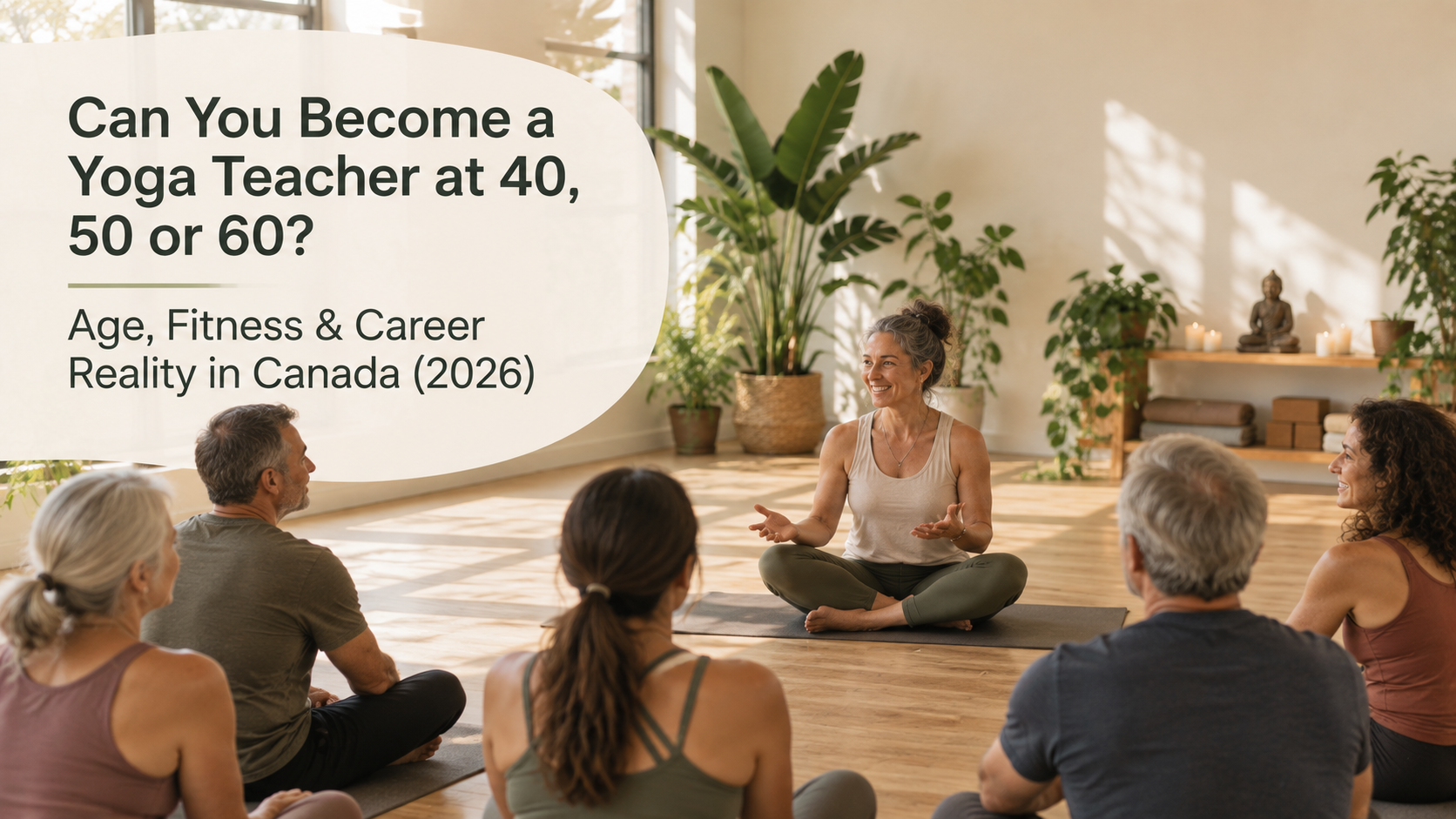
 Can You Become a Yoga Teacher at 40, 50 or 60? Age, Fitness & Career Reality in Canada (2026)
If you’re asking whether it’s too late to train as a yoga teacher, you’re not alone. Every month, thousands of Canadians in their 40s, 50s and 60s search for exactly this. Maybe you’ve practised yoga for years and want to teach. Maybe you’re leaving a corporate job and craving something more meaningful. Maybe you just want proof that age won’t hold you back.
This guide answers the question directly: Can you become a yoga teacher at 40, 50 or 60? Yes. Age is not the barrier most people assume it is. What actually matters is your health, your commitment, and your understanding of the real Canadian job market. Let’s walk through the facts, the fitness reality, and the practical steps.
The Short Answer: Yes, Age Is Not a Barrier
There is no upper age limit for yoga teacher training. Credentialing organizations that register yoga schools and teachers, such as Yoga Alliance, publish training-hour and completion requirements for their registered designations. None of them mention age anywhere in their criteria.
Look around any yoga class in Canada and you’ll see instructors in their 50s, 60s and beyond. Many started teaching later in life. Some began their first 200-hour training after retiring from an unrelated career. Others switched from nursing, teaching, law, or corporate management.
Age brings something training programs value: life experience. Older trainees often bring patience, self-awareness and a grounded teaching presence that younger graduates are still developing. Studios and community programs know this. Many actively want instructors who can relate to midlife and older students, since that demographic makes up a large share of regular yoga attendees.
The real question isn’t “Am I too old?” It’s “Am I ready to commit to training and teaching?” That’s a readiness question, not an age question. We’ll unpack it in detail below.
Why Yoga Teacher Training Attracts Career Changers Over 40
Yoga teacher training has become one of the most popular second-career paths in Canada. There are clear reasons for this trend.
First, burnout. Many people in their 40s and 50s have spent two or three decades in demanding careers. Yoga offers a complete contrast: slower pace, physical engagement, and a clear sense of purpose.
Second, personal transformation. A large number of people discover yoga during a difficult period — illness, divorce, grief, or a health scare. The practice becomes personally meaningful before it becomes professional. Teaching feels like a natural next step.
Third, flexible formats. Because so much training now happens online, career-changers can complete a full certification without relocating or taking a leave of absence from work. This flexibility appeals to people managing family responsibilities, phased retirement, or a desire to reduce work hours without stopping entirely. If you’re weighing whether a remote format actually counts, our guide to whether online yoga teacher training is recognized in Canada walks through exactly how certification and registration work.
Fourth, growing demand for teachers who understand aging bodies. As Canada’s population ages, more community centres, retirement facilities and private clients want instructors who can teach gentle, chair-based or therapeutic yoga with credibility. A 55-year-old teacher often has more authority with a 65-year-old student than a 24-year-old graduate does — not because of skill, but because of shared life experience.
None of this means training is easy. It requires real commitment: consistent classes, written assignments, practice teaching, and often a structured module schedule. But age itself is not the obstacle. Readiness is.
Is There an Age Limit for Yoga Teacher Training?
No. Yoga schools set their own admission criteria, and none impose an upper age limit. Most ask for a minimum age (usually 18), a baseline personal practice, and a willingness to complete the full program.
Some schools ask applicants to complete an intake questionnaire about their yoga background and physical history. This isn’t age screening. It’s a way to match trainees with the right program and pacing. If you’re comparing programs, our buyer’s guide to choosing the best yoga teacher training in Canada breaks down what to look for beyond price, including curriculum depth, format, and support after graduation.
It’s worth noting that teacher-training credentials track completed hours and continuing education, not the age of the teacher. Once you’re certified, your credential carries the same weight whether you’re 24 or 64. Studios, clients and employers check your certification and your teaching ability, not your birth year.
 Do You Need to Be Super Flexible or Fit to Train as a Yoga Teacher?
This is the single biggest myth blocking people over 40 from signing up. No, you don’t need to touch your toes, do a full backbend, or hold a headstand to train as a yoga teacher.
Yoga teacher training builds skill progressively. Most 200-hour programs assume a working knowledge of basic postures, not advanced flexibility. You’ll learn anatomy, alignment, breathing techniques, sequencing, and teaching methodology. Physical practice is part of the curriculum, but instructors modify poses for every body, including yours.
Flexibility is trainable. Strength is trainable. What matters more is consistency: showing up to practice several times a week for months before training starts, so your body has some familiarity with sustained movement, breath control and basic postures.
Different styles ask for different physical baselines:
- Restorative and Yin yoga require the least physical intensity. Poses are held using props, with minimal strength or flexibility demand. Karma Yoga’s Restorative Yoga and Yin Yoga programs are built around exactly this pacing.
- Hatha yoga sits in the middle — steady pacing, foundational postures, manageable for most fitness levels.
- Vinyasa and Ashtanga are more physically demanding, involving flowing sequences and more strength-based poses.
Many people over 40 start with a gentler specialty certification, then add a more dynamic style later once their strength and stamina improve.
What Fitness Level Do You Actually Need at 40, 50 or 60?
You need functional fitness, not athletic fitness. That means the ability to:
- Sit and stand from the floor with reasonable control
- Hold basic standing postures for 30-60 seconds
- Follow breathing exercises without dizziness
- Complete a 60-90 minute class without severe fatigue
- Move joints through a comfortable, pain-free range of motion
You do not need six-pack abs, a 90-minute unbroken flow practice, or the ability to do arm balances. Most teacher trainees, regardless of age, spend the first few weeks of training building stamina they didn’t have before they started.
Preparation matters more than natural ability. If you’re planning to enrol in training within the next six to twelve months, start building a regular practice now. Three sessions a week is a realistic target. Add short walks or light strength training on off-days. This isn’t about looking a certain way. It’s about giving your joints, muscles and nervous system time to adapt before you ask them to do more.
Research backs up what many older practitioners already feel. A review out of Harvard-affiliated Brigham and Women’s Hospital, reported by the Harvard Gazette, found that older adults who practised yoga gained walking speed and leg strength compared with those who stayed inactive. A separate systematic review from the University of Edinburgh found that yoga improved balance, flexibility, leg strength and mental wellbeing in adults over 60. That’s the population many of you will eventually teach — and the population many of you already belong to. Karma Yoga’s Chair Yoga certification is specifically designed around teaching this kind of lower-intensity, high-accessibility class.
Common Physical Concerns (Joints, Old Injuries, Recovery) and How to Manage Them
Almost everyone over 40 carries some physical history: a knee that clicks, a lower back that tightens, a shoulder that never quite recovered from an old injury. This is normal, and it does not disqualify you from training or teaching.
Joint sensitivity. Yoga, done correctly, is one of the gentler movement practices available. Props — blocks, straps, bolsters, chairs — exist specifically to reduce joint strain. Good teacher training programs teach you how to use these tools for your own practice and for future students.
Old injuries. Tell your training school about any injuries during enrolment. Reputable programs adjust expectations and offer modifications rather than pushing you past safe limits. If you have a significant injury history, a short consultation with a physiotherapist before training starts is a smart, low-cost precaution.
Menopause and hormonal changes. Many women begin or deepen a yoga practice during perimenopause and menopause, often for symptom relief — better sleep, reduced anxiety, improved joint comfort. This life stage does not prevent teacher training; it often motivates it.
Recovery time. Bodies over 40 generally need more recovery between intense training sessions than they did at 25. Because online programs let you set your own pace between modules, this is often easier to manage than a fixed, in-person intensive.
Teaching students with limitations. If you’re drawn to working with older adults, people recovering from injury, or people with chronic conditions, a specialty certification like Special Needs Yoga builds specifically on this skill set.
When to get medical clearance. If you have a cardiovascular condition, uncontrolled high blood pressure, recent surgery, or a chronic condition affecting mobility, speak with your doctor before starting an intensive training program. This is standard, responsible advice for any new physical activity — not a yoga-specific restriction.
None of these concerns are disqualifying. They’re simply things to plan around, the same way any physically engaged adult plans around their own history.
The Real Canadian Job Market for Yoga Teachers Over 40
Let’s talk numbers, because career decisions deserve facts, not just encouragement.
Yoga instructors fall under the broader occupational category of fitness and recreation program leaders in Canada’s National Occupational Classification system. According to Job Bank Canada, the government’s official labour market platform, roughly 13% of workers in this occupational group are aged 50 and over, and the median retirement age sits around 63. Labour demand and supply are projected to stay broadly balanced nationally over the next decade, though outlooks vary significantly by province and region.
What does this mean practically? The fitness and wellness sector is not a young person’s industry in the way some assume. A meaningful share of instructors are already in the 50+ bracket, and the field has room for experienced entrants, not just fresh graduates.
Income realities matter too. Most yoga teachers do not earn a full-time living from teaching alone, especially in the first two to three years. Many combine group classes with private clients, corporate wellness sessions, workshops, or online teaching. Our detailed breakdown of yoga teacher salary in Canada walks through realistic income patterns so you can plan rather than guess.
The honest takeaway: yoga teaching at 40, 50 or 60 works best as a purposeful career shift built on realistic expectations, not a guaranteed high-income career. For most people entering at this stage, it succeeds as a combination of teaching income, personal fulfillment, and often a phased transition away from a previous career rather than a single dramatic leap.
How Older Students Bring an Advantage to Teaching Yoga
Training programs, and later, employers and clients, consistently point to specific advantages that older trainees bring to the room.
Life experience translates into relatability. A 50-year-old teacher speaking to a room full of midlife and older students carries an authority that’s hard to fake. Students trust guidance from someone who has lived through similar physical and life transitions.
Patience and listening skills. Decades in a career, in parenting, or in caregiving build patience that shows up naturally in teaching style. Older instructors are frequently praised for calm, unhurried instruction that reduces student anxiety, particularly for nervous beginners.
Lower ego, higher presence. Many older trainees enter yoga teaching without needing to prove athletic prowess. This shifts the teaching focus toward breath, alignment and safety rather than performance — exactly what most students, especially over 40 themselves, are looking for.
Professional transferable skills. Careers in healthcare, education, HR, and management all build communication and group-facilitation skills directly useful in a yoga classroom. Trainees rarely start from zero; they redirect skills they already have.
Market alignment. As covered above, a significant share of regular yoga students are 40+, and that number is growing as Canada’s population ages. Studios and community programs actively seek instructors who can teach gentle, therapeutic, chair-based, or restorative classes with genuine understanding, not textbook theory. This is a structural advantage for older trainees, not a disadvantage.
None of this diminishes younger teachers, who bring their own strengths. The point is simple: age is not a liability in this profession. In several respects, it’s a professional asset.
Choosing the Right Yoga Teacher Training Program After 40
Not every program suits every stage of life. Here’s what to evaluate carefully before enrolling.
Curriculum depth and pacing. Ask how the program structures its modules, how much of the training is self-paced versus scheduled, and how much support is available if you need more time on a section.
Format. A remote, module-based format lets you train around a job, family responsibilities, or physical recovery needs, without travel or a fixed intensive schedule. Our guide on whether online training is recognized covers what to check before you enrol in a remote program.
Modifications and inclusive teaching. Ask whether the school actively trains modifications for different bodies, or whether the default curriculum assumes a young, highly flexible trainee. This tells you a lot about whether the program will support you, and whether it will prepare you to teach the wide range of bodies you’ll eventually meet in your own classes.
Cost transparency. Understand exactly what’s included in the tuition before you commit. Our breakdown of yoga teacher training costs in Canada explains what typically drives price differences between programs.
Timeline. Ask how long the program realistically takes to finish, factoring in your own pace, not just the advertised minimum. Our guide to how long it actually takes to become a yoga teacher in Canada sets realistic expectations.
 Becoming Self-Employed: Business, Insurance and Legal Basics in Canada
Many yoga teachers eventually work as self-employed instructors, teaching private clients, community classes, or their own online sessions. This means understanding a few practical business basics early.
Business registration. In most provinces, sole proprietors must register their business name with the provincial government unless they operate strictly under their own legal name. Registering typically also assigns you a federal business number through the Canada Revenue Agency. The Government of Canada’s guide to registering a sole proprietorship outlines the exact steps by province.
Liability insurance. Most studios, community centres and corporate clients require instructors to carry their own liability insurance before booking classes. This protects you if a student is injured during a class you’re teaching. Several Canadian providers offer yoga-specific policies at reasonable annual rates.
Taxes and expenses. As a self-employed instructor, you’ll file business income on your personal tax return and can typically deduct legitimate expenses — training costs, mats and props, and a portion of home space used for teaching or practice. A bookkeeper or accountant familiar with self-employed fitness professionals is a worthwhile early investment.
GST/HST registration. If your total self-employed income exceeds $30,000 in a calendar year, you’re generally required to register for and collect GST/HST. Below that threshold, registration is optional.
None of this is complicated once you understand the basic steps, but it catches new teachers off guard if they assume teaching yoga is purely a creative pursuit with no administrative side.
Common Myths About Age and Yoga Teaching — Debunked
Myth: “Only young, flexible instructors get hired.” Reality: studios and clients hire teachers who can build and retain a loyal class. Relatability, communication skill and reliability matter more than age or flexibility.
Myth: “You need years of advanced practice before training.” Reality: most 200-hour programs ask for a modest baseline of regular practice, not advanced mastery. Training itself builds your skill.
Myth: “It’s too late to start a new career at 50 or 60.” Reality: many successful teachers began training in their 50s and 60s, often after full careers in unrelated fields. Teaching careers in this field can run well into a person’s 70s, since the physical demands are adjustable and self-paced.
Myth: “Your body has to look a certain way to teach yoga credibly.” Reality: credibility comes from clear instruction, safety awareness and genuine presence, not body shape or advanced postures. Students respond to how a teacher makes them feel, not how a teacher looks in a pose.
Myth: “Online certification isn’t a ‘real’ credential.” Reality: this is a common and reasonable question, and the answer depends on the specific school and designation. Our guide on whether online yoga teacher training is recognized in Canada explains exactly what to check before you enrol.
Letting go of these myths early makes the decision to train much clearer. The real considerations are financial readiness, physical health, and time commitment — not age itself.
Real Talk: Challenges You Might Face (and How to Handle Them)
Honesty matters here, because an overly rosy picture doesn’t serve you well.
Physical fatigue during intensive study periods. Concentrated study blocks are tiring at any age, but recovery takes longer for most people over 40. Pace your modules with rest days built in, and don’t schedule major life events immediately after a heavy study stretch.
Comparison with younger trainees. You may train alongside people in their 20s who move through postures more easily. This isn’t a reflection of your teaching potential. Focus on your own progress, not comparison.
Slower income ramp-up. As covered earlier, most new teachers build income gradually. Treat your first year as relationship-building and reputation-building, not immediate profit.
Balancing training with existing responsibilities. Many trainees over 40 are managing careers, children, aging parents, or all three. An online, self-paced format tends to fit real life better than a fixed in-person intensive.
Imposter feelings. It’s common to doubt whether you’re “yoga teacher material,” especially if you don’t fit the Instagram image of the profession. Most successful teachers over 40 report this feeling fading once they start teaching real students and see real results.
None of these challenges are unique to older trainees — they show up for career-changers of every age. Naming them honestly just makes the transition smoother.
Step-by-Step: How to Start Your Yoga Teacher Journey at Any Age
- Build a consistent personal practice. Aim for three sessions a week for at least three to six months before applying to a program.
- Get medical clearance if needed. If you have any cardiovascular, joint, or chronic health concerns, check with your doctor first.
- Research training programs carefully. Compare curriculum, format, cost and timeline using the questions outlined above.
- Plan your finances. Factor in training costs, potential income gaps in year one, and business setup costs like insurance and registration.
- Register your training and complete the program. Follow through on assignments, practice teaching, and any required teaching hours.
- Register with a recognized credentialing body, if that credential matters for the studios or clients you want to work with.
- Start teaching, and keep learning. Continuing education, mentorship, and additional certifications (restorative, chair yoga, prenatal, special needs) can expand your opportunities over time.
This process looks the same whether you’re 28 or 58. The steps don’t change. What changes is the life experience you bring into the room on day one.
Conclusion: Can You Become a Yoga Teacher at 40, 50 or 60?
The answer to “Can you become a yoga teacher at 40, 50 or 60?” is a clear yes. Age, fitness and career reality in Canada all point the same direction: this profession welcomes career-changers at every stage of adulthood. No governing body sets an age limit. Fitness requirements are functional, not extreme. And the Canadian job market includes a meaningful share of instructors over 50, teaching a growing population of students who want guidance from someone who understands their stage of life.
What actually determines success isn’t your birth year. It’s your consistency, your realistic financial planning, and your willingness to start as a beginner again, even after decades in another career. Prepare your body gradually, choose a training program that fits your life, and go in with clear expectations about income and timeline.
If you’re ready to take the next step, check out our 200-Hour Yoga Teacher Training Online program, built with exactly this in mind: a flexible, self-paced curriculum and a teaching community that includes trainees starting their second, third or fourth career.