 The Truth About Yoga Teacher Training in Canada: Online vs In-Person (What Actually Matters in 2026)
You’ve decided to become a yoga teacher. Maybe you’ve been practicing for years. Maybe a single class changed your life. Either way, you’re now facing a decision that feels bigger than it should: do you train online or in person?
The internet is full of opinions on this. Schools talk up their own format. Social media shows highlight reels, not the hard moments. And the price difference between formats can be thousands of dollars — making the stakes feel even higher.
This guide cuts through the noise. It looks at what actually shapes your training experience in Canada, what the certification bodies require, and what students who have done both formats say honestly. Whether you’re in Vancouver, Halifax, or a small town in northern Ontario, this is the information you need before you spend your money.
What Yoga Teacher Training Actually Certifies You to Do
Before comparing formats, it helps to understand what a yoga teacher training (YTT) actually produces: a graduate who can safely and effectively lead yoga classes.
In Canada, most yoga teacher training programs align with the standards set by Yoga Alliance, the internationally recognized credentialing body. Their 200-hour designation (RYT 200) is the most common entry-level certification. Some schools also align with the Canadian Yoga Alliance, which has its own standards for programs offered within Canada.
Neither body mandates that training happen exclusively in person. However, both have specific curriculum requirements around contact hours, practicum teaching, and anatomy content. What changes between online and in-person formats is how you meet those hours — not whether you meet them.
The core curriculum in any accredited 200-hour program covers:
- Yoga techniques, training, and practice
- Teaching methodology
- Anatomy and physiology
- Yoga philosophy, lifestyle, and ethics
- Practicum (observed teaching practice)
A legitimate program delivers all of this regardless of format. If a program you’re considering doesn’t cover all five areas, that’s a red flag — not a format issue.
 The Real Differences Between Online and In-Person Training in Canada
This is where honest comparison matters most. The differences are real, but they’re not always what people assume.
Physical Adjustment and Hands-On Learning
In-person training gives you something online cannot fully replicate: the experience of being physically adjusted by a teacher and learning to do the same for students.
Hands-on assists are a nuanced, consent-driven part of yoga teaching. In a studio setting, you practice giving and receiving adjustments in real time. You feel what correct alignment actually feels like in a body that isn’t your own. That tactile feedback accelerates learning in a way that watching a screen doesn’t.
However, it’s worth noting that the yoga industry has shifted significantly around physical assists in recent years. Many schools and studios — including major ones in Toronto and Vancouver — now train teachers to lead entirely without hands-on adjustment, relying instead on verbal and visual cuing. If you plan to teach in an environment that prioritizes consent-forward, non-touch instruction, this gap may be smaller than it sounds.
Yoga International has covered this shift in detail, and it reflects a genuine evolution in how the profession thinks about physical contact.
Community and Peer Learning
This is where in-person training has the clearest edge.
Living through an intensive training with a cohort of people — whether in a week-long retreat format or a weekend program spread over months — builds relationships that online programs struggle to replicate. Many yoga teachers cite their training cohort as their first professional network, their first community of peers, and often lifelong friends.
Online programs have worked hard to address this. Breakout rooms, group chats, community platforms, and live virtual sessions help. But the unstructured time — the conversations over lunch, the late-night questions, the shared vulnerability of trying something new together — is hard to manufacture on a screen.
If community is a core part of why you’re pursuing teacher training, in-person has a meaningful advantage. If you’re self-directed, already have a strong yoga community, and primarily need the certification and curriculum content, online can work very well.
Schedule Flexibility and Accessibility
Online training has made yoga teacher certification accessible to people who couldn’t otherwise get it. That matters.
A parent managing childcare. A person living in rural New Brunswick with no local studio offering YTT. A shift worker who can’t commit to weekend intensives. A person with a health condition that makes travel difficult. For all of these people, a well-structured online program opens a door that would otherwise be closed.
Statistics Canada data consistently shows that access to professional development in Canada is highly unequal across geography. Urban centers like Montreal, Toronto, Calgary, and Vancouver have dozens of YTT options. Many smaller cities and rural areas have none. Online training directly addresses that gap.
The flexibility also goes the other way: online programs sometimes attract people who underestimate the commitment involved. A self-paced structure requires genuine self-discipline. The dropout rate in flexible online programs is a real issue across professional education broadly — and YTT is no exception.
Cost Differences
The price gap between online and in-person training in Canada is significant.
Most reputable in-person 200-hour programs in Canada range from $3,000 to $6,500 CAD, depending on location, accommodation, and the reputation of the school. Retreat-style immersive programs that include lodging can exceed that. Schools in cities like Toronto or Vancouver tend to charge more than programs in smaller communities.
Online 200-hour programs from accredited schools typically range from $800 to $2,500 CAD. Some are structured as payment plans. Some include lifetime access to content.
The cost difference is real. But so are the hidden costs in each format. Online training may require you to invest in a quality yoga mat, props, a good camera for practicum recordings, and a reliable internet setup. In-person training may require travel, accommodation, meals, and time off work.
Do the full math before deciding price is the deciding factor.
What Canadian Yoga Schools Actually Offer in 2026
The Canadian yoga education landscape has changed considerably since 2020. The pandemic forced schools to develop online delivery fast. Some did it poorly. Many did it well and kept online programs running even after studios reopened.
Notable In-Person Programs in Canada
Downward Dog Yoga Centre in Toronto has offered teacher training programs for many years and maintains a consistent reputation for rigorous curriculum and experienced faculty.
Semperviva Yoga in Vancouver offers both 200-hour and advanced training, with a format built around their studio community on the West Coast.
Moksha/Modo Yoga operates across Canada and offers teacher training tied specifically to their hot yoga format. If you intend to teach Modo-style classes, their certification is worth understanding specifically.
Shanti Yoga School offers training in various Canadian locations including programs in British Columbia.
This is not an exhaustive list. Yoga Alliance’s school directory allows you to search registered schools by country and state/province. Use it.
Hybrid Programs: The Middle Ground
Several Canadian schools now offer hybrid models — typically a self-paced online curriculum component combined with a required in-person intensive weekend or week. This format has grown in popularity for good reason.
Hybrid training lets you do the content-heavy work (anatomy modules, philosophy lectures, teaching methodology) on your own schedule, then come together for the practicum, adjustment work, and peer teaching that benefits from being in a room together.
If you can find a well-designed hybrid program from an accredited school, it often provides the best balance of flexibility and experiential learning. Ask specifically: How many hours are in-person? What does the in-person component cover? What is the format of practicum evaluation?
 How to Evaluate Any Yoga Teacher Training Program
Format is only one factor. Here’s what actually separates strong programs from weak ones — regardless of whether they’re online or in-person.
Accreditation Status
Check whether the school is a Registered Yoga School (RYS) with Yoga Alliance or recognized by the Canadian Yoga Alliance. Accreditation means the curriculum has been reviewed against a published standard. It also means your certification will be recognized by studios that require Yoga Alliance credentials from their teachers.
Unaccredited programs may still offer valuable training. But if your goal is to work in yoga studios, gyms, or wellness centers in Canada, accreditation matters practically.
Faculty Experience and Credentials
Who is teaching the program? What is their training background? How long have they been teaching?
A 200-hour program led by someone with 500+ hours of training and ten years of teaching experience is a fundamentally different investment than one run by a recently certified teacher. This is true online and in-person.
Read teacher bios carefully. Look for teachers whose backgrounds align with the style of yoga you want to teach. A program heavy on Iyengar-trained faculty will produce different graduates than one rooted in vinyasa or Kundalini traditions.
Curriculum Transparency
A legitimate program will tell you exactly what the curriculum covers. You should be able to see a full breakdown of hours by category before you enroll. If a school won’t share this, or is vague about how hours are counted, that’s a warning sign.
Yoga Alliance’s curriculum requirements are publicly available. Compare any program you’re considering against those standards directly.
Student Reviews and Graduate Outcomes
Where do graduates from this program work? What do they say about the training six months or two years later? Early enthusiasm in reviews posted immediately after training is natural. Look for reviews written with some distance — the ones that speak to whether the training actually prepared someone to teach.
Ask the school if you can speak with a recent graduate. Any school confident in its program should welcome that request.
 Practicum Requirements: A Detail Most People Overlook
Your practicum — the observed teaching component — is where your training becomes real. This is where you stand in front of other humans and teach yoga, receive feedback, and do it again.
Yoga Alliance requires a minimum number of practicum hours as part of the 200-hour curriculum. For 200-hour programs, this includes observed teaching, feedback sessions, and practice teaching.
In-person programs typically handle this within the program itself. You teach your cohort. Faculty observe and give feedback. The structure is built in.
Online programs handle this in a variety of ways. Some require you to record teaching sessions and submit them for faculty review. Some use live video sessions where you teach classmates virtually. Some require you to teach externally — real classes in your community — and submit documentation.
The quality of practicum feedback is arguably more important than the quantity of hours. Ask specifically: Who reviews your teaching? How detailed is the feedback? How many times do you teach before graduation?
Weak practicum feedback is one of the most common complaints graduates have about underprepared YTT programs, regardless of format.
Province-Specific Considerations for Canadian Students
Canada’s yoga industry is not regulated at the provincial level the way healthcare professions are. There is no provincial licensing body for yoga teachers. This means your certification is not a legal requirement to teach — it’s an industry credential.
However, practical considerations vary by province.
In British Columbia, the yoga community is large and well-established. Studios in the Lower Mainland and on Vancouver Island commonly require Yoga Alliance credentials and may ask for liability insurance. Westland Insurance and other Canadian brokers offer fitness instructor liability policies that most practicing teachers carry.
In Ontario, the market is similarly credential-focused in urban areas. Toronto has dozens of studios, most of which post hiring requirements that include RYT status.
In Quebec, the yoga market has some unique characteristics. French-language instruction is valued, and some community studios and rec centers prioritize teachers who can offer bilingual classes.
In Atlantic Canada and the territories, the market is smaller. Independent teaching — community classes, private clients, workplace wellness — may be more common than studio employment. This changes the practical weight of your certification, though it doesn’t reduce the value of good training.
No matter where you are in Canada, BF&M or similar Canadian insurance providers can help you understand liability coverage requirements. Carry insurance before you teach, regardless of format or certification.
 What Students Who’ve Done Both Say
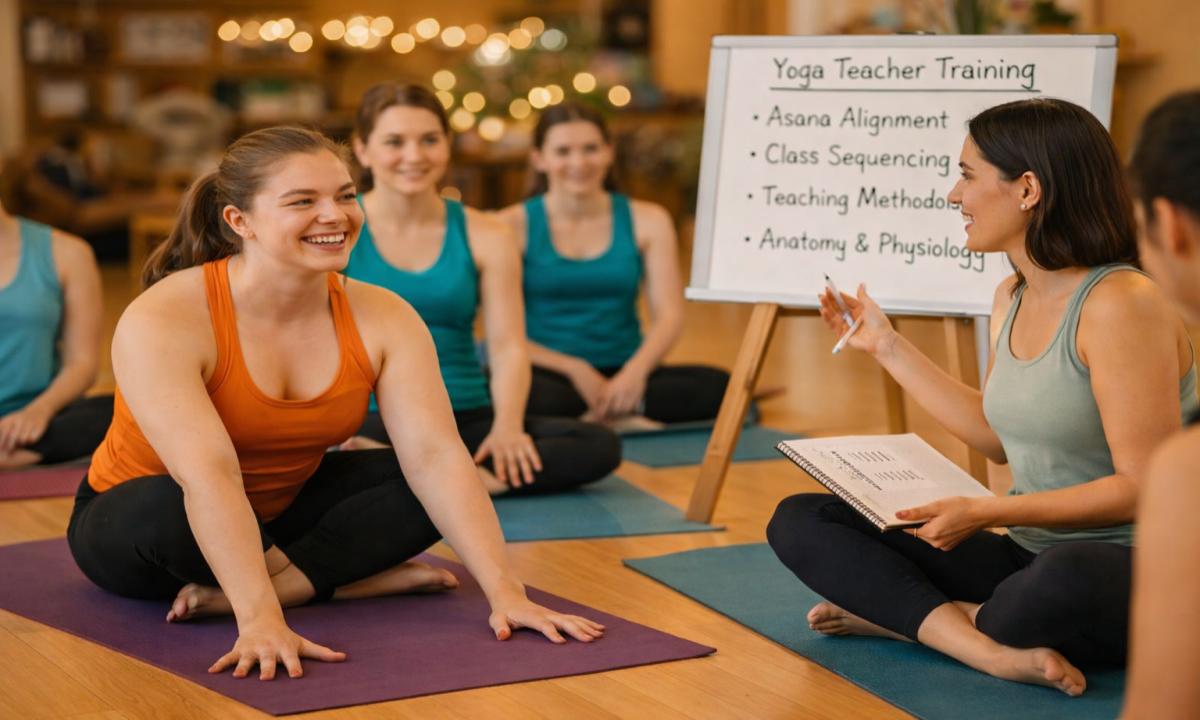
Anecdotally — and this reflects patterns in teacher forums, Reddit communities like r/yoga, and published interviews with yoga educators — graduates of in-person programs consistently describe the community and immersive experience as the most valuable part of their training.
Graduates of online programs most often cite flexibility and affordability as the deciding factors, and many describe having to work harder to build their professional community after training concluded.
Graduates of hybrid programs tend to express the highest overall satisfaction, particularly when the in-person intensive was well-structured and faculty were engaged.
The honest pattern: format matters less to professional outcomes than the quality of the program, the engagement of the student, and the teaching experience accumulated after certification.
A graduate who completes a rigorous online program and then teaches 200 classes in their first year will be a better teacher than a graduate of a prestigious in-person program who teaches sporadically. Training is the beginning, not the destination.
Red Flags to Watch For in Any YTT Program
Whether you’re evaluating an in-person retreat in the Okanagan or an online program headquartered in Ontario, these warning signs apply universally.
No clear Yoga Alliance registration. Don’t take the school’s word for it. Search the Yoga Alliance school directory directly and confirm their status.
Vague or inaccessible curriculum details. If a school won’t show you the hour breakdown before you enroll, that’s a problem.
Instructors with minimal credentials. Teaching credentials matter. A 200-hour training run by 200-hour graduates is a different thing than one led by experienced senior teachers.
Unrealistic promises. No training program can guarantee you work. If a school promises you’ll be teaching full-time within months of graduating, treat that with skepticism.
No practicum structure. If the school can’t explain how and by whom your teaching will be evaluated, the practicum component is likely weak.
Pressure to enroll quickly. Legitimate schools don’t need to manufacture urgency. Take the time you need to research.
Making the Decision: A Framework for Your Situation
There is no universally correct answer between online and in-person training. The right format depends on your life, your learning style, your finances, and your goals.
Use this framework to guide your decision.
Choose in-person training if:
- You learn best through physical experience and real-time feedback
- Building a cohort community is important to you
- You intend to teach styles where hands-on adjustment is central (Iyengar, therapeutic yoga)
- You can commit the schedule and budget it requires
- There is a high-quality accredited program accessible to you
Choose online training if:
- Your location, schedule, or finances make in-person training inaccessible
- You are self-directed and disciplined with flexible formats
- You already have a strong yoga community and don’t depend on training for connection
- You want to prioritize curriculum content and have strategies to build teaching experience afterward
Choose a hybrid program if:
- You want the flexibility of online with the experiential depth of in-person
- There is a reputable hybrid program within reasonable travel distance for the in-person intensive
- You can commit to attending the in-person component reliably
Whatever format you choose, prioritize accreditation, faculty quality, practicum structure, and curriculum transparency above all else. These factors will shape your training far more than whether you log in from home or drive to a studio.
After Certification: What Actually Builds a Yoga Teaching Career
Certification is the starting line. What you do after training determines whether you build a sustainable yoga teaching practice.
Teach as much as possible. Every class you lead in your first year teaches you more than any training module. Volunteer at community centers. Offer classes to friends. Sub for established teachers. Say yes to opportunities that scare you a little.
Continue your education. The 500-hour advanced certification builds on the 200-hour foundation. Specialty training in areas like yin yoga, prenatal yoga, trauma-informed yoga, or yoga for seniors expands your reach and your skills. Organizations like Accessible Yoga offer training that helps teachers serve more diverse students.
Build your community. Studio relationships, workshop collaborations, and referrals from other teachers matter enormously in a field where word of mouth drives bookings. The community you build during or after training is a long-term professional asset.
Invest in business fundamentals. Most YTT programs teach yoga, not business. Learn the basics of scheduling, payment systems, social media for wellness professionals, and how to price your services. Mind Body Online and Vagaro are platforms used widely by Canadian yoga teachers and studios.
Conclusion: The Truth About Yoga Teacher Training in Canada: Online vs In-Person (What Actually Matters in 2026)
The debate between online and in-person yoga teacher training often focuses on the wrong things. People compare price tags and convenience without examining the factors that determine whether training actually prepares someone to teach.
The truth is this: format matters less than program quality. An in-person training with poor faculty, thin curriculum, and no real practicum will produce less capable teachers than a well-designed online program with experienced instructors and structured teaching feedback.
What actually matters in 2026 — and what always has — is whether the program is accredited, who is teaching it, how robust the practicum is, and how seriously you engage with the material. The modality is secondary.
Canada’s yoga education landscape offers genuinely strong programs in both formats. Do the research. Verify credentials. Ask hard questions. And once you’re certified, remember that the training was the beginning. The real education starts the first time you stand at the front of a room and say, “Welcome. Let’s begin.”