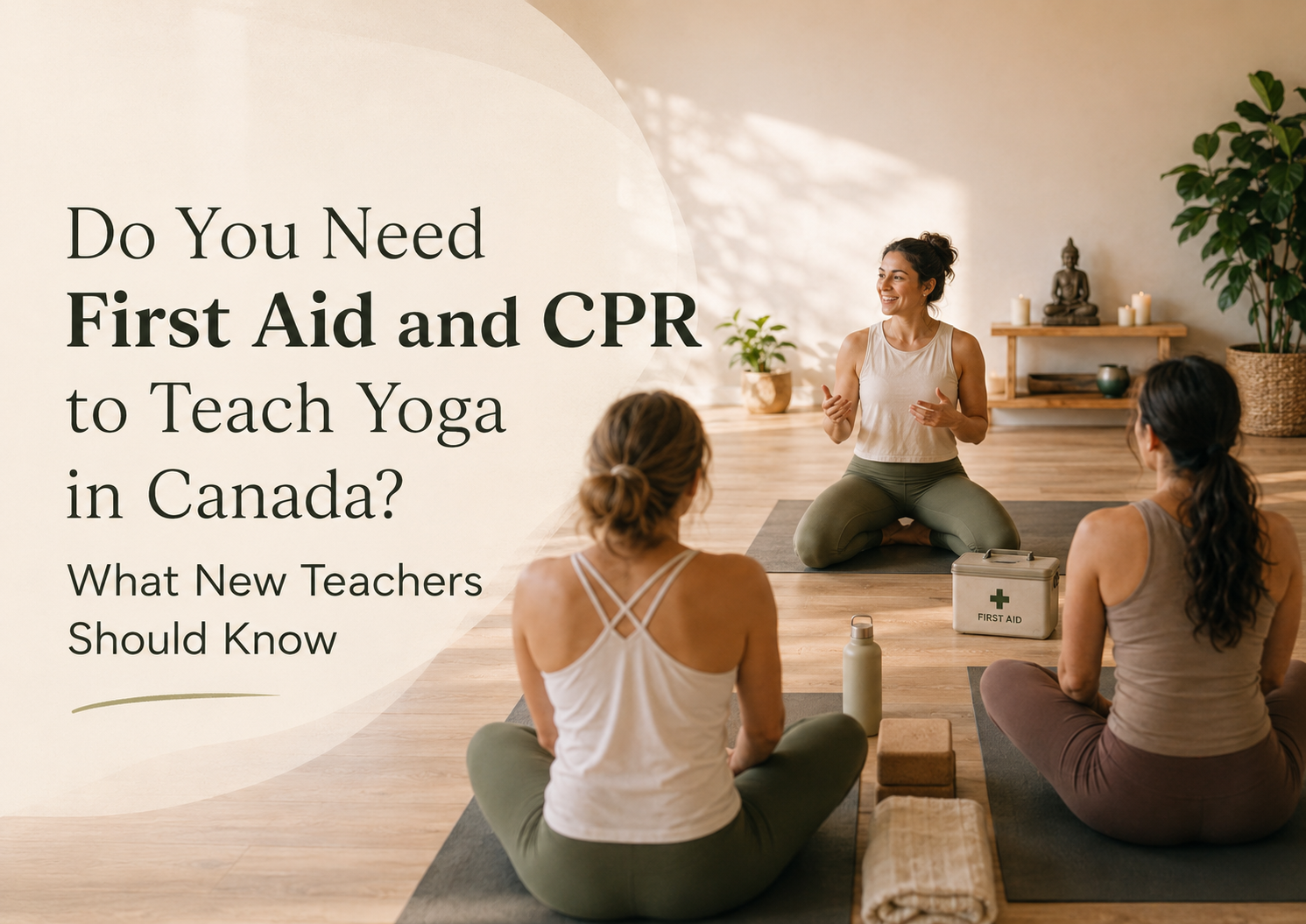
 Do You Need First Aid and CPR to Teach Yoga in Canada? What New Teachers Should Know
Becoming a yoga teacher involves more than learning how to sequence poses and guide a class. Once you begin teaching real students, you also need to think about safety.
That leads to an important question: do yoga teachers need First Aid and CPR certification in Canada?
Do You Need First Aid and CPR to Teach Yoga in Canada? What New Teachers Should Know is not a question with one simple national rule. Canada does not have a single federal licence for yoga teachers. There is also no Canada-wide law stating that every person who teaches yoga must personally hold a First Aid and CPR certificate.
However, that does not mean First Aid and CPR are irrelevant.
Provincial workplace safety rules can require qualified first aid personnel to be available at a workplace. Studios, gyms, recreation centres, insurers, professional fitness organizations, retreat centres, and other employers can also establish their own requirements.
In practice, a new yoga teacher may discover that First Aid and CPR become necessary for a particular job even when there is no general law requiring every yoga instructor in Canada to hold them.
There is another reason to consider the training. Medical emergencies can occur almost anywhere. A student could faint, experience chest pain, have a seizure, fall, choke, suffer an allergic reaction, or go into cardiac arrest. The event may have nothing to do with yoga itself. As the person leading the class, however, you may be one of the first people available to respond.
This guide explains what Canadian yoga teachers should know, how workplace rules differ from yoga certification requirements, and what type of First Aid and CPR course makes sense for a new teacher.
Information in this article is general educational information. Workplace and occupational health requirements can change and vary between provinces and territories. Always confirm the current requirements that apply where you teach.
The Short Answer: Is First Aid and CPR Legally Required to Teach Yoga in Canada?
There is no single national law that requires every yoga instructor in Canada to personally hold First Aid and CPR certification simply because they teach yoga.
That distinction matters.
Yoga teaching itself is not regulated in the same way as professions such as medicine, nursing, or physiotherapy. A yoga teacher does not receive a government-issued professional licence that automatically includes a nationwide First Aid requirement.
However, workplace health and safety rules operate separately.
The Government of Canada provides links to provincial and territorial first aid authorities because workplace first aid requirements vary across jurisdictions. First Aid Training — Government of Canada
That means the correct question is often not simply, “Does Canada require yoga teachers to have First Aid?”
A better question is:
What First Aid requirements apply to the workplace, employer, professional organization, insurance policy, or venue where I intend to teach?
For example, a studio could need a qualified first aid attendant available during operating hours. That does not necessarily mean every yoga teacher working there must be certified. The studio may already have another appropriately trained employee on site.
Another facility might take a different approach and require every instructor to provide proof of First Aid and CPR before teaching.
A recreation department may have its own hiring standard. A fitness registry may make current certification a condition of membership. An insurer may also attach requirements to a particular professional designation or insurance program.
This is why two yoga teachers in the same Canadian city can encounter different requirements.
One may teach independently in a private studio. Another may work for a municipal recreation centre. Another may teach outdoor classes. Another may teach children.
Their legal and contractual responsibilities may not be identical.
For a new teacher, the safest approach is to check three things before accepting work: the rules in your province, the policies of the organization hiring you, and the requirements of your insurance or professional registration.
 Workplace First Aid Rules Are Provincial, Not Yoga-Specific
Most confusion comes from mixing together yoga certification rules and workplace health and safety rules.
They are not the same thing.
British Columbia provides a useful example.
Under current WorkSafeBC requirements, employers must make sure workers can receive appropriate first aid when they become injured or ill at work. Employers determine what they need through a workplace first aid assessment. That assessment considers factors such as the number of workers, workplace hazards, accessibility, ambulance response and other barriers to emergency care.
The WorkSafeBC workplace first aid guidance explains that requirements can include appropriate equipment, first aid facilities, first aid attendants and emergency transportation arrangements. WorkSafeBC First Aid Requirements
B.C. changed its occupational first aid system on November 1, 2024. Current certification levels are called Basic, Intermediate and Advanced First Aid. Older Occupational First Aid Level 1, 2 and 3 certificates remain recognized as equivalents until they expire.
Ontario uses a different system.
As of June 22, 2026, Ontario’s Workplace Safety and Insurance Board modernized its First Aid Program and renamed Emergency First Aid as Basic First Aid and Standard First Aid as Intermediate First Aid. For workplaces covered by Ontario’s Workplace Safety and Insurance Act, at least one person with the appropriate certification must be available. The required level depends partly on the number of workers on a shift.
The WSIB First Aid Program is therefore an important resource for Ontario teachers and studio owners. Ontario WSIB First Aid Program
These rules illustrate the important point: there is no universal yoga-specific rule that can replace checking your provincial or territorial requirements.
Does the Yoga Teacher Personally Have to Be the First Aider?
Not always.
Workplace first aid legislation often focuses on whether adequate first aid services are available to workers. It does not necessarily state that the yoga instructor teaching a class must personally hold the certificate.
Imagine a large fitness centre.
The centre might have several yoga teachers, fitness instructors, reception employees and managers working at the same time. The employer may designate specific employees as first aid attendants and ensure they have the appropriate training.
A yoga instructor working there could therefore teach without personally being the designated first aider, assuming the employer’s legal and internal requirements are otherwise satisfied.
Now imagine a smaller operation.
Perhaps one yoga teacher opens a studio alone at 6:00 a.m. and teaches before any other staff arrive. The studio may decide that the instructor must carry certification because no other trained employee is available.
Independent teachers face another layer.
If you rent a room, operate your own yoga business, hire employees, run retreats or contract other teachers, your responsibilities may be different from those of an employee working for an established studio. Worker classification and occupational safety obligations can vary by jurisdiction.
This is why new teachers should never assume that someone else is handling emergency preparedness.
Ask the studio or employer directly.
Find out whether instructors must carry First Aid and CPR. Ask who the designated first aider is during your teaching hours. Find out where the first aid kit and AED are located. Ask what procedure the facility follows when someone needs emergency medical attention.
These are simple professional questions. They also tell you a great deal about how seriously a facility takes student and employee safety.
What Is the Difference Between First Aid, CPR and AED Training?
People often use First Aid and CPR as though they mean the same thing. They do not.
CPR stands for cardiopulmonary resuscitation. CPR training focuses primarily on recognizing and responding to cardiac and breathing emergencies.
Modern CPR courses also commonly include training with an automated external defibrillator, or AED.
The Canadian Red Cross CPR program includes skills for cardiovascular emergencies, choking, CPR and AED use. CPR Level A focuses on adults. CPR Level C adds CPR and choking response for children and babies.
Canadian Red Cross CPR and AED information is useful when comparing CPR levels. Canadian Red Cross CPR Courses
First Aid covers a wider range of situations.
Depending on the course, training may address wounds, bleeding, sudden medical emergencies, bone and joint injuries, head and spinal injuries, environmental emergencies and other situations that can happen before professional medical help arrives.
For example, the Canadian Red Cross currently offers Basic First Aid and Intermediate First Aid programs. Its Intermediate course includes CPR as well as subjects such as wounds, head and spinal injuries, bone and joint injuries and sudden medical emergencies. Certification is generally valid for three years, subject to the rules of the authority that has jurisdiction over the workplace.
The Canadian Red Cross Intermediate/Standard First Aid course provides a useful overview of what broader First Aid training covers. Canadian Red Cross Intermediate First Aid
For a yoga teacher, that broader knowledge can be especially relevant because not every emergency in a yoga class involves cardiac arrest.
A participant might fall and hit their head. Someone may become dizzy when standing. A student could experience a medical emergency unrelated to the physical activity.
CPR prepares you for a narrow group of life-threatening emergencies.
First Aid gives you a broader emergency-response foundation.
 What First Aid and CPR Course Should a New Yoga Teacher Take?
There is no single course that is automatically correct for every Canadian yoga teacher.
Your employer and provincial requirements come first.
If you want a broadly useful starting point, however, completing a recognized workplace First Aid course that includes CPR and AED training is usually more practical than taking a stand-alone CPR class alone.
For many instructors, that means Basic First Aid or Intermediate First Aid with CPR/AED from a recognized provider.
The terminology can vary between organizations and provinces, so pay attention to what the certificate actually qualifies you to do rather than relying only on the course name.
CPR Level A covers adult emergencies. That may be adequate for some adult-only teaching environments.
CPR Level C includes adults, children and infants. For teachers who may eventually work with families, teenagers or children, CPR-C can provide broader coverage. It can also prevent you from needing a second course later when your teaching opportunities change.
Do not assume that the cheapest online CPR certificate will satisfy an employer.
Some professional organizations specifically require an in-person practical component.
For example, the BC Recreation and Parks Association Yoga Fitness requirements state that registered fitness leaders and students must maintain current CPR and First Aid certification. BCRPA requires an in-person practical component and lists recognized providers. Its minimum standard includes CPR-A plus Emergency/Basic or Standard/Intermediate First Aid.
BCRPA Yoga Fitness CPR and First Aid Requirements
That does not mean every yoga instructor in British Columbia must register with BCRPA. It shows how a professional organization can create standards beyond the minimum requirement associated with simply calling yourself a yoga teacher.
Before registering for a course, show the course information to your employer if you are unsure. A five-minute check can prevent paying for training that does not meet the required standard.
First Aid Requirements Can Affect Insurance and Professional Registration
Insurance adds another reason to check your credentials carefully.
A yoga teacher’s insurance requirements depend on the actual policy and insurer. Never assume that every Canadian yoga insurance policy has identical conditions.
Some professional programs clearly connect First Aid and CPR certification with insurance eligibility.
BCRPA is one example. Its registered fitness leaders receive commercial general liability insurance through its program, but BCRPA states that instructors must maintain valid registration and current CPR and First Aid certifications. If those credentials expire, the insurance coverage connected to that registration can be affected.
BCRPA’s fitness liability insurance information explains those requirements directly. BCRPA Fitness Liability Insurance
Other yoga-specific policies can have different eligibility requirements.
For example, the Yoga Association of Alberta’s group insurance information emphasizes teacher qualifications and association membership rather than presenting CPR as a universal condition in its published eligibility information.
That difference is precisely why teachers should read their own policy rather than relying on advice from another instructor.
Ask the insurer whether your teaching activities are covered. Tell them whether you teach online, privately, outdoors, at retreats, to children, or in other specialized settings.
Also confirm whether your professional credentials must remain current during the entire insurance period.
A certificate that expired last month is not the same as a current certificate.
Keeping your documents organized makes this much easier. Save digital copies of your yoga teacher training certificate, First Aid certificate, CPR certificate, insurance policy and professional registrations in one secure folder.
When a studio asks for proof, you can provide it immediately.
Does a 200-Hour Yoga Teacher Training Include First Aid and CPR?
Not automatically.
A 200-hour yoga teacher training and a First Aid certificate are separate credentials unless the school specifically includes recognized First Aid training in its program.
The purpose of a foundational yoga teacher training is to prepare you to teach yoga. Programs normally cover subjects such as yoga techniques, anatomy, teaching methodology, professional responsibilities and the broader study of yoga.
First Aid training has its own curriculum, skills assessments and certification standards.
The current Yoga Alliance RYT 200 standards list completion of a 200-hour training with a Registered Yoga School as the training requirement for the RYT 200 credential. First Aid or CPR is not listed as a separate requirement for obtaining the RYT 200 credential.
 Yoga Alliance’s current RYT credential standards can be reviewed directly for the credential requirements. Yoga Alliance RYT Standards
That means graduating from a 200-hour teacher training does not necessarily make you First Aid certified.
It also works in the opposite direction. Having a First Aid certificate does not qualify someone to teach yoga.
The two types of training serve different purposes.
Your yoga teacher training should teach you how to build and guide appropriate classes, communicate clearly, understand basic anatomy, manage a group and work within the scope of a yoga teacher.
First Aid and CPR training prepares you to respond when an injury or medical emergency occurs.
A well-prepared teacher benefits from both.
When comparing 200-hour YTT programs, ask whether First Aid or CPR training is included, recommended or completed separately. If it is included, verify whether the certificate comes from a provider recognized by the workplace authority in your province.
What If You Teach Yoga Outdoors, at Retreats or in Remote Locations?
Location changes the risk calculation.
Teaching a class in a downtown studio five minutes from an ambulance station is different from leading yoga at a rural retreat that is an hour from emergency medical care.
The farther you move from immediate professional help, the more important emergency planning becomes.
Outdoor yoga introduces additional factors such as heat, cold, uneven terrain, insects, allergic reactions and changing weather.
Retreats can create even greater complexity. Participants may be staying overnight. Transportation may be limited. Cell service may be unreliable. A hospital could be far away.
In these environments, a standard urban First Aid course may not be the end of your planning.
The Canadian Red Cross offers Remote First Aid specifically for people who live or work in non-urban or remote environments. The course includes CPR, wound care, head and spinal injuries, environmental emergencies, extended care and evacuation planning.
Canadian Red Cross Remote First Aid
The correct level of training still depends on the location and applicable workplace requirements. The point is that teachers should match emergency preparation to the environment.
Before running a retreat, know the exact address or coordinates that emergency services would need. Know where the nearest medical facility is. Check cell coverage. Know how participants could be evacuated. Identify who on the teaching team has current training.
If an AED is available at the property, know where it is before the retreat begins.
You do not want to learn your emergency plan during an emergency.
Teaching Children, Seniors or Specialized Populations
The students you teach can also affect the training that makes sense.
If you exclusively teach healthy adults in a general studio, adult CPR may satisfy the requirements of some organizations.
If you teach children, CPR-C or specialized child-care First Aid may be more appropriate. The Canadian Red Cross offers dedicated child-care First Aid programs covering CPR and emergencies involving children and infants. Those courses are designed in part to address requirements that can apply in regulated child-care settings.
Teaching children’s yoga in a general studio does not automatically make you a child-care worker. However, a school, camp, day-care centre or municipal program may impose additional standards.
Ask before you accept the contract.
Teachers working with older adults may also value broader First Aid training. The chances of encountering existing health conditions naturally increase in many older populations.
That does not mean yoga teachers should diagnose students or act as health-care professionals.
Quite the opposite.
Good training helps teachers understand the limits of their role. Your responsibility is not to diagnose the cause of a medical event. It is to recognize that something may be wrong, activate emergency medical services when appropriate and provide care within the limits of your training until professional help arrives.
That distinction protects both the student and the teacher.
The best instructors understand their scope of practice.
Knowing when to stop teaching and call for help is part of professional judgment.
First Aid Certification Is Only One Part of Running a Safe Yoga Class
A certificate is useful, but emergency preparedness goes beyond a card in your wallet.
Before teaching at a new location, identify where the first aid kit is stored. Make sure you can access it quickly.
Find out whether the building has an AED and where it is located.
Know the facility’s street address. This sounds obvious, but instructors who travel between rented rooms and community facilities can easily arrive without knowing the exact address emergency services would need.
Know how to contact the front desk or building manager.
Keep walkways and exits clear.
Inspect obvious hazards before students enter. A wet floor, damaged prop or blocked exit can become a preventable problem.
Pay attention to the environment during class. If someone appears unwell, do not pressure them to continue.
Teachers also need to stay within the scope of yoga instruction. Avoid diagnosing injuries. Avoid promising that yoga will cure medical conditions. When a student presents an issue outside your training, refer them to an appropriate regulated health professional.
Good safety practices are often simple.
They are also consistent.
A teacher who knows emergency procedures, carries appropriate insurance, maintains current certifications and teaches within their professional limits creates a stronger environment for students than someone who relies entirely on confidence or experience.
Safety is not about expecting something bad to happen.
It is about being prepared if it does.
 How to Choose a Recognized First Aid Provider in Canada
Do not choose a First Aid course based solely on convenience.
Start with the requirements of the organization that needs the certificate.
Provincial workplace authorities recognize specific standards and providers. The certificate that works in one context may not automatically satisfy every employer or professional organization.
In British Columbia, WorkSafeBC maintains a current list of organizations authorized to provide workplace First Aid training. The list includes organizations such as the Canadian Red Cross and numerous other approved providers.
WorkSafeBC’s approved training provider directory is the best place to verify B.C. workplace certification before paying for a course. WorkSafeBC Approved First Aid Training Providers
Ontario similarly maintains a list of WSIB-approved providers under its updated 2026 First Aid Program.
Choose a course that provides the level your employer actually requires.
Confirm whether CPR and AED are included.
Confirm whether hands-on practical training is required.
Check the expiry date once you receive the certificate.
Canadian Red Cross Basic and Intermediate First Aid certifications are generally issued for three years, and B.C. workplace Basic, Intermediate and Advanced First Aid certificates are also valid for three years.
Do not wait until the morning of a new job to discover that your certificate expired six months ago.
Adding the renewal date to your calendar when you first receive the certificate takes less than a minute.
Will First Aid and CPR Help You Get Yoga Teaching Work?
They can.
The Government of Canada’s Job Bank notes that recreation, sport and fitness instructors typically need relevant training or experience and that certification is commonly required in a specific recreation or fitness activity or in First Aid or emergency care.
Canada’s Job Bank requirements for yoga instructors provide useful context for what employers may expect. Yoga Instructor Job Requirements — Government of Canada Job Bank
A studio manager looking at two new teachers may feel more comfortable hiring the person who already has their documentation organized.
It removes one administrative obstacle.
It also tells the employer that you have thought beyond teaching poses.
For a new teacher trying to build experience, that matters.
Your first teaching opportunities may not come from a traditional yoga studio. You might teach at a gym, community centre, recreation department, corporate wellness program, seniors’ residence, hotel or retreat centre.
Those organizations can have more formal hiring and safety procedures than a small independent studio.
Having recognized First Aid and CPR certification broadens the number of environments in which you are prepared to work.
You should not treat the certificate as a marketing gimmick. It does not make someone a better yoga teacher by itself.
It does make you more prepared for emergencies and can satisfy requirements that would otherwise prevent you from taking a job.
For many new teachers, that makes the investment worthwhile.
Do You Need First Aid and CPR to Teach Yoga in Canada? The Bottom Line
So, Do You Need First Aid and CPR to Teach Yoga in Canada? What New Teachers Should Know comes down to an important distinction.
There is no single Canada-wide rule saying that every yoga instructor must personally hold First Aid and CPR certification before teaching a yoga class.
That is only the beginning of the answer.
Provincial workplace safety regulations can require appropriate First Aid coverage. Employers can require instructors to be certified. Recreation and fitness organizations may make First Aid and CPR part of professional registration. Insurance programs can attach their own conditions. Teaching children, working remotely or running retreats can create additional considerations.
For a new yoga teacher who intends to teach professionally, recognized First Aid and CPR/AED training is a sensible credential to have even when a particular studio does not legally require you to carry it.
Before choosing a course, verify the requirements in your province and with the places where you intend to teach.
Then keep your certification current.
Being a professional yoga teacher means knowing how to guide a class. It also means understanding your scope, preparing for foreseeable risks and knowing what to do when an ordinary class suddenly becomes an emergency.
If you’re ready to become a yoga teacher, check out our 200-hour Yoga Teacher Training page to learn how foundational teacher training can prepare you to confidently begin teaching.
A strong 200-hour YTT gives you the teaching foundation. Adding current First Aid and CPR training can help you enter the profession better prepared for the practical realities of working with real students.