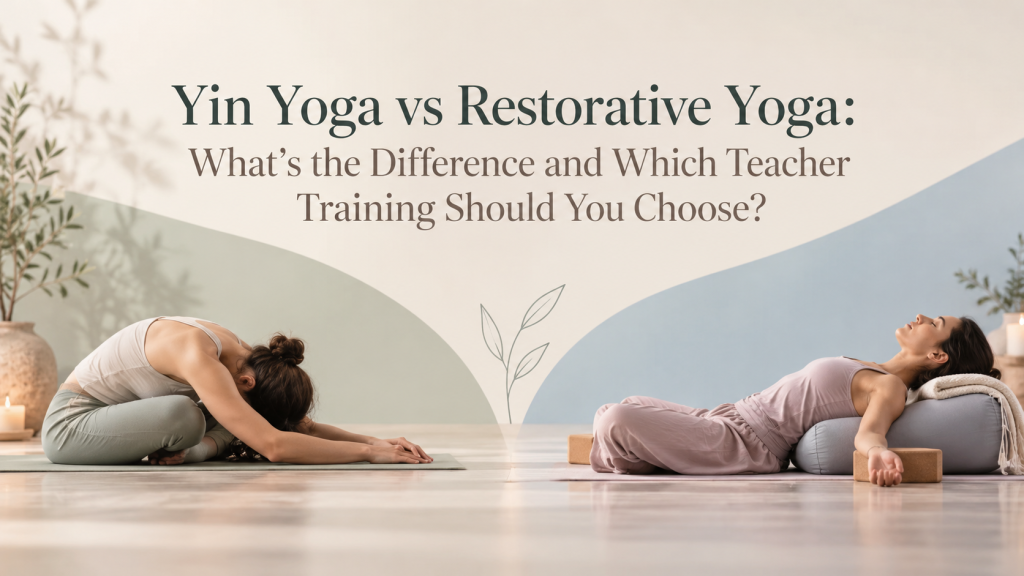
 Yin Yoga vs Restorative Yoga: What’s the Difference and Which Teacher Training Should You Choose?
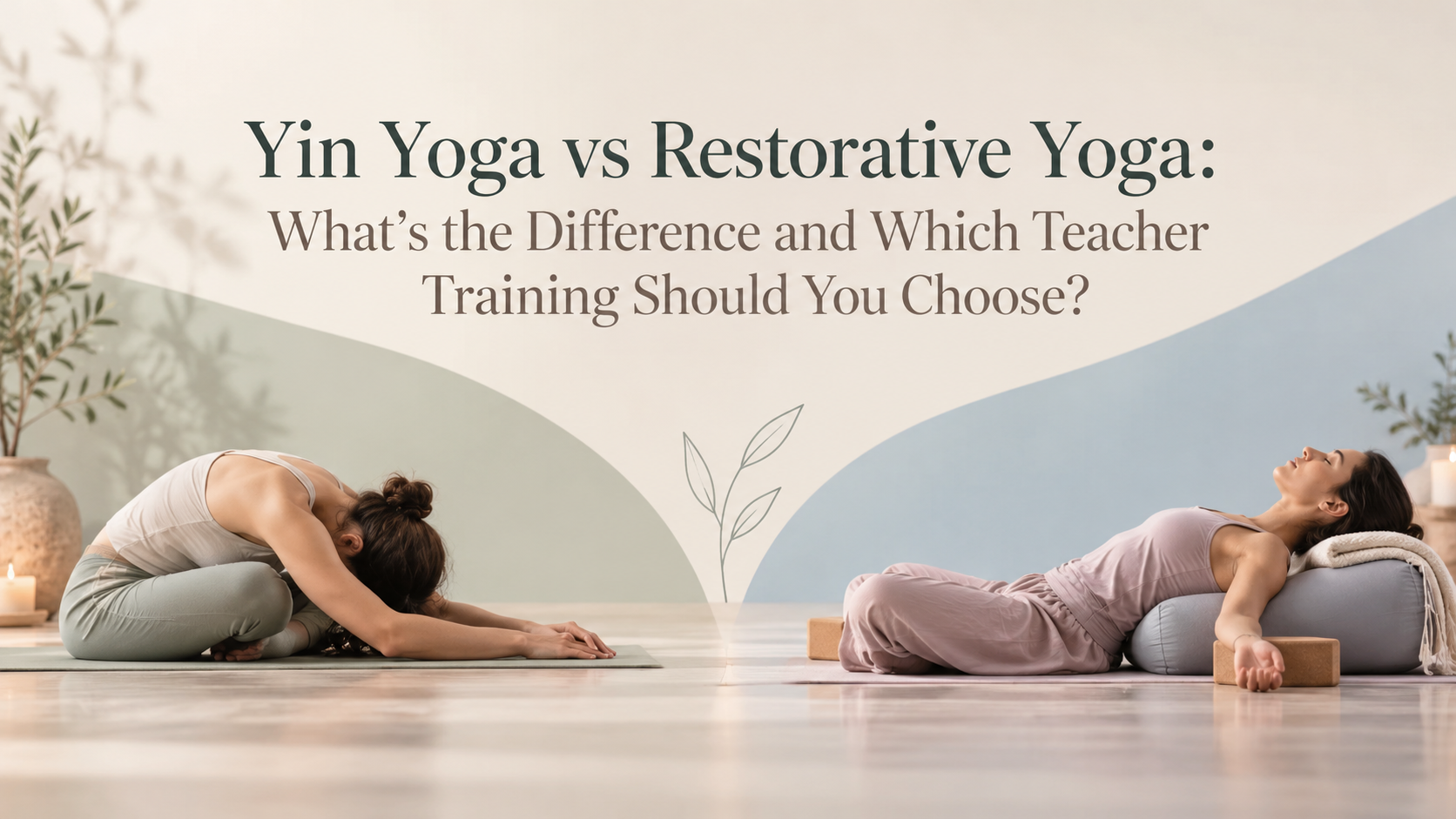
You lie on the floor. A bolster supports your spine. A blanket covers your legs. The room is quiet. Is this yin yoga or restorative yoga?
Many students can’t tell. Many new teachers can’t either. Both styles are slow, both use long holds, and both ask you to let go. But they are different practices, and the difference matters if you plan to teach.
This guide answers the question in the title: Yin Yoga vs Restorative Yoga: What’s the Difference and Which Teacher Training Should You Choose? You will learn where each style came from, what each one targets, and how each one feels. You will also learn what a good training covers and how to choose the right path for your goals.
What Is Yin Yoga?
Yin yoga is a slow practice built on long, passive holds. Students usually stay in each pose for three to five minutes. Some teachers hold longer. The goal is to place mild, steady stress on deep tissues, such as the connective tissue around the joints, the ligaments, and the fascia.
The style has a short history. Paulie Zink, a martial arts champion, taught a practice he called Taoist yoga. Paul Grilley studied with Zink in the 1980s. Grilley then blended those ideas with his anatomy training and with the work of Dr. Hiroshi Motoyama, who studied the body’s energy pathways. His student Sarah Powers suggested the name “Yin Yoga” and added a meditative approach. Today, Grilley and author Bernie Clark teach widely. You can read more on Paul Grilley’s official site and on Bernie Clark’s yin yoga resource site.
The name comes from the Chinese concept of yin and yang. Yang describes active, rhythmic, muscular movement. Yin describes still, quiet, and passive qualities. A vinyasa class is yang. A yin class is yin.
A typical yin class follows a clear pattern:
- Students sit or lie close to the floor.
- They move into a pose until they feel a mild stretch. Teachers call this point the “edge.”
- They relax their muscles and stay still.
- They come out slowly and rest before the next pose.
Props help in yin yoga, but they play a supporting role. A bolster or block protects a joint so the target area can receive gentle tension. Common poses include Butterfly, Dragon, Sphinx, Saddle, and Caterpillar. Butterfly is closely related to Bound Angle Pose, which many students already know.
Yin yoga is not effortless. It asks for patience and honesty. Students must stay with sensation, and they must back off when the feeling turns sharp. Teaching that skill is a large part of a yin teacher’s job.
What Is Restorative Yoga?
Restorative yoga is a practice of deep rest. The goal is not to stretch anything. The goal is to help the body and mind recover. Students hold each pose for ten to twenty minutes, and sometimes longer. Props carry nearly all of the body’s weight.
The roots of restorative yoga lie in the teaching of B.K.S. Iyengar. He used props such as blankets, bolsters, and straps to help students who were injured or ill. His student Judith Hanson Lasater later shaped the modern form of the practice. She is one of the founders of Yoga Journal, and she wrote Relax and Renew, the first book devoted entirely to restorative yoga. You can see the book on Shambhala Publications’ Relax and Renew page.
Restorative classes use very few poses. A class might include only four or five. A teacher might build a single pose with three bolsters, two blankets, and an eye pillow. The student then stays in that shape long enough for the body to settle.
Common restorative poses include:
- Supported Child’s Pose over a bolster
- Supported Bridge with a block under the pelvis
- Legs Up the Wall, often with a bolster under the hips
- Reclined Bound Angle, with bolsters under the spine and knees
- Supported Side-Lying Twist
Comfort is the rule. A restorative student should feel no strain. If a pose creates effort, the teacher adjusts the props until the effort disappears. The teacher also keeps the room warm, quiet, and dim.
Restorative teachers need sharp observation skills. Every body needs different support. A setup that works for one student may fail another. Teachers must learn to see tension, offer a better setup, and then stay out of the way.
The Core Differences Between Yin and Restorative Yoga
Both styles are slow. Both ask students to stay still. Beyond that, they differ in purpose, method, and feel.
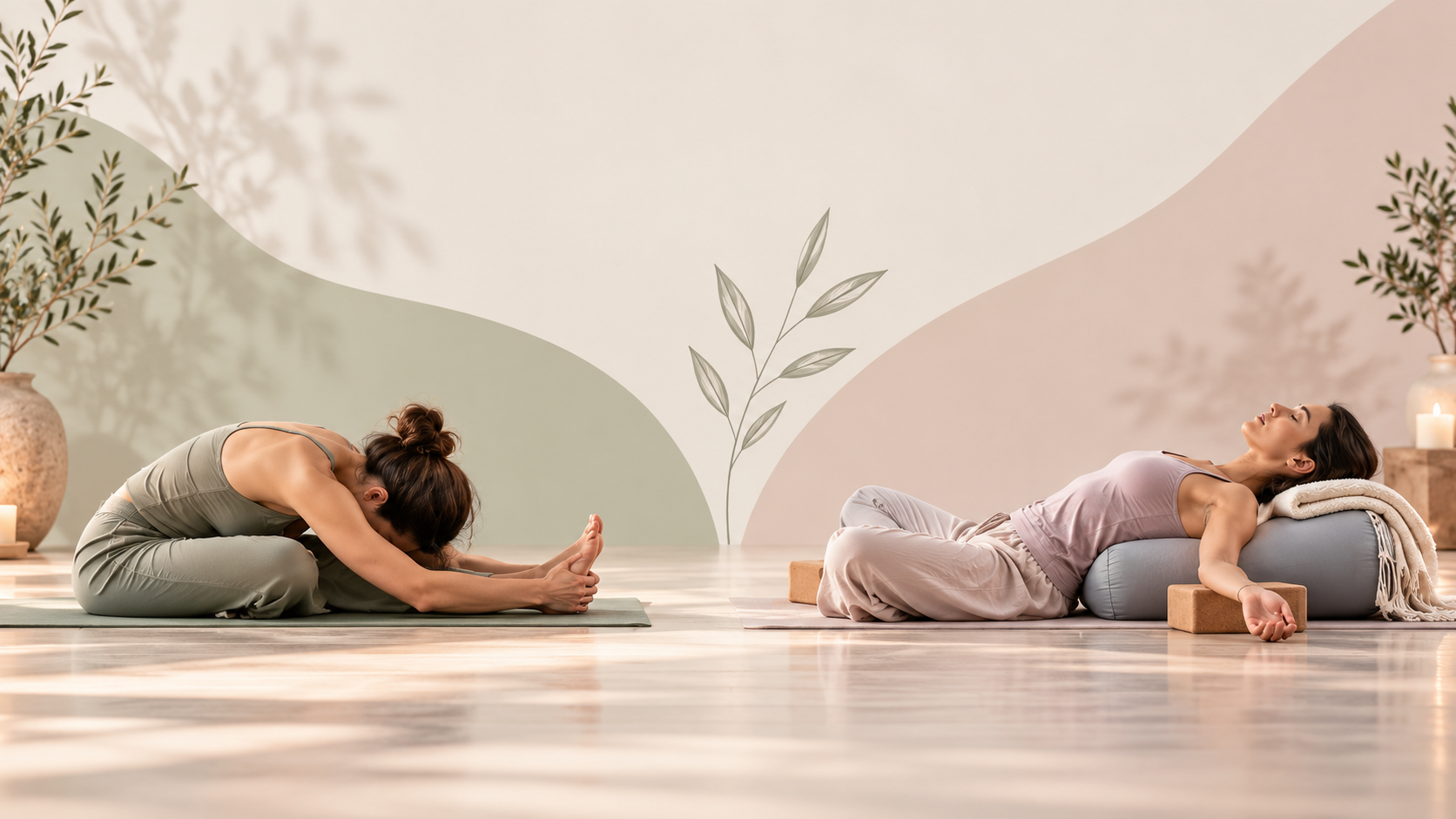
Purpose. Yin yoga applies gentle, targeted stress to connective tissue. Restorative yoga removes stress so the body can rest. Put simply, yin asks the body to work a little. Restorative asks it to do nothing.
Sensation. In yin yoga, students feel a mild to moderate stretch or deep pull. The sensation can be strong, but it should never be sharp. In restorative yoga, students should feel supported and comfortable. If they feel a stretch, the setup needs changes.
Time in each pose. Yin holds usually last three to five minutes. Restorative holds typically last ten to twenty minutes.
Use of props. Yin yoga uses props to protect joints and make poses accessible. Restorative yoga uses props as the foundation of every pose.
Body position. Many yin poses are seated or reclined, and a few are demanding, like Dragon or Saddle. Restorative poses are almost always fully supported and lying down.
Tissue focus. Yin yoga aims at fascia, ligaments, and joint capsules. Restorative yoga does not target any tissue. It aims at calm.
Mental focus. Both styles invite mindfulness. Yin classes often treat the discomfort of long holds as an object of meditation. Restorative classes often use breath awareness, body scans, or guided relaxation.
A simple test helps. Ask, “Is the student meant to feel a stretch?” If yes, the class is likely yin. If no, it is likely restorative.
Some classes blend the two. You may see a class called “Yin and Restore.” That is fine. A good teacher still knows which elements come from which tradition, and tells students what to expect.
What Happens in the Body: Stress, Rest, and What Research Says
Students often ask what these practices actually do. Teachers must answer honestly and avoid exaggerated claims.
Start with the nervous system. The sympathetic branch prepares you for action. The parasympathetic branch supports rest and digestion. Slow, quiet practices tend to encourage the second mode. Restorative yoga is built for this purpose. Yin yoga can also support relaxation, although a deep hold may keep some students alert.
Now consider the tissues. Connective tissue responds to load. Yin teachers often say that long holds “work the fascia.” Researchers are still studying fascia, and the science is not settled. A careful teacher says that yin yoga is designed to load connective tissue gently. A careful teacher does not promise that it will “release” or “detox” anything.
What does research say about yoga in general? The National Center for Complementary and Integrative Health reports that yoga may help with stress, low back pain, and overall wellness. It also warns that many studies are small or of limited quality. In most cases, it says, yoga has shown promise rather than proof. Few large studies look at yin or restorative yoga on their own.
This gap matters for teachers. You can say that students often report feeling calmer after class. You can say that research on yoga is encouraging. You should not claim that yin yoga cures anxiety or that restorative yoga treats illness. That standard protects your students. It also protects your reputation.
Safety is part of the picture too. Yin yoga asks for deep, sustained positions. Students with hypermobility, joint conditions, or recent injuries need extra care. Restorative yoga is gentler, but staying in one position for twenty minutes can still be uncomfortable. Pregnant students often need adjusted setups. A good training teaches you to ask questions, offer options, and refer students to a medical professional when needed.
Who Benefits From Each Style?
Both styles are open to many students. Each one tends to suit different needs.
Yin yoga often suits:
- Active people, such as runners, cyclists, and lifters, who want balance
- Students who sit for long hours and feel stiff in the hips or lower back
- Students who enjoy a meditative challenge
- People who want a slow practice but still want to feel something
Yin yoga pairs well with more active styles. Many athletes add one class a week. They often say it helps them slow down and notice their bodies.
Restorative yoga often suits:
- Students who feel exhausted, overwhelmed, or overstimulated
- People recovering from a hard season of work or life
- Students who find stretching uncomfortable
- Beginners who want a gentle introduction to yoga
- Students who want help winding down before sleep
Restorative yoga also helps people who struggle to relax. These students often discover that rest is a skill. They learn it one supported pose at a time.
As a teacher, you will meet both groups. Many studios offer both formats, and some students attend both in the same week. Knowing which class a student needs builds trust and keeps your classes full.
You will also meet students who cannot yet tell the difference. They may arrive at a yin class expecting rest and leave frustrated. Or they may attend a restorative class expecting a stretch. A clear class description helps. So does a short welcome at the start of class that explains what to expect.
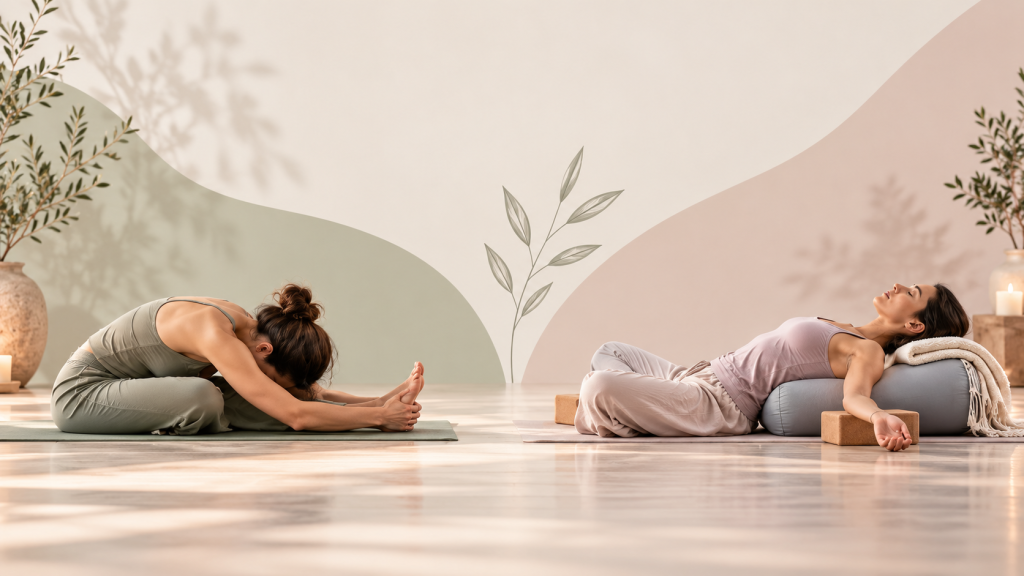 What Do Yin and Restorative Teacher Trainings Teach?
Training programs in both styles share some content. They also differ in important ways.
A yin yoga teacher training usually covers:
- The history and philosophy of yin yoga
- Yin and yang theory and how it applies to practice
- The anatomy of connective tissue and joints
- Individual differences in bone shape and range of motion
- How to find and teach the “edge”
- Sequencing classes for different areas of the body
- Cues for stillness and meditation
- Contraindications and safe modifications
Our own Yin Yoga Teacher Training Online program follows this kind of outline. It includes anatomy and physiology, energy systems, injuries and special conditions, history, the business of teaching, and a teaching practicum.
Good yin training also teaches you how to speak during long holds. Silence is part of the style. New teachers often talk too much. A strong program coaches you to use fewer words and trust the pauses.
A restorative yoga teacher training usually covers:
- The history of restorative yoga and its link to Iyengar yoga
- The relaxation response and the basics of stress physiology
- Prop setups for each major pose
- How to adjust props for different bodies
- How to create a calm room, including lighting, temperature, and sound
- Teaching with a soft voice and slow pace
- Guided relaxation, breathing practices, and meditation
- Working with common concerns, such as back pain or pregnancy
- Scope of practice and when to refer out
Our Restorative Yoga Teacher Training Online program is another example of this specialty path. If guided relaxation interests you most, you can also explore our Yoga Nidra Teacher Training Online.
Both trainings should teach you to hold space. That means you create a safe, welcoming room, respect each student’s limits, and stay within your scope as a yoga teacher. You do not diagnose or treat medical conditions.
Specialty courses are usually shorter than a foundational program. Yoga Alliance, a large yoga credentialing body, sets a 200-hour standard for foundational teacher training. Specialty courses build on that base. You can review the standards on the Yoga Alliance website.
How to Choose the Right Teacher Training
Choosing a training is a big decision. It costs time and money, and it shapes how you teach. Use these questions to guide you.
1. What is your goal?
Some people want to teach full time. Others want to deepen their own practice. Others want to add a skill to a career such as massage therapy or physiotherapy. Your goal shapes the right program.
2. What is your current level?
If you are new to teaching, start with a broad foundation. If you already teach, a yin or restorative specialty may be the right next step. Not sure you are ready? Read our guide on how much yoga experience you need before teacher training.
3. Who are the teachers?
Look at their experience. How long have they taught? Who did they study with? Strong programs share this information openly. Read teacher bios and look for real, verifiable credentials.
4. What is the curriculum?
Ask for a full outline. Look for anatomy, teaching practice, and feedback. A program that only lectures will not prepare you to lead a room.
5. What does the certification mean?
Ask which organization certifies the program. Our programs are certified through Yoga Alliance International. Requirements differ by employer, so check with the studios or gyms where you hope to work.
6. What is the format?
Programs run in person, online, or in a hybrid format. In-person training gives you hands-on feedback, which helps with restorative prop work. Online training offers flexibility. Think about how you learn best, and ask how feedback and mentorship work.
7. What does it cost, and what does it include?
Ask about tuition, books, props, payment plans, and refund policies. A trustworthy school answers these questions clearly.
8. What do graduates say?
Read reviews. Ask whether graduates feel prepared to teach and whether they felt supported.
Take your time. A good school welcomes your questions. A school that rushes you is a red flag.
Should You Take a 200-Hour Training First?
For most aspiring teachers, yes. A 200-hour program is the standard entry point. It teaches the core skills every yoga teacher needs, including anatomy, class design, cueing, ethics, and the history and philosophy of yoga.
Yin and restorative trainings assume you already know these basics. They add depth in one area. Without the foundation, you may struggle to apply the specialty skills. You may also find it harder to land work, since many studios and gyms ask for a 200-hour certificate as a minimum. Our article on whether you can get a job after online yoga teacher training in Canada explains what studios look for.
A strong 200-hour program often includes some yin and restorative content. That gives you a taste before you commit to more. If one style speaks to you, you can follow up with a specialty course.
Consider three paths:
- Path one: Complete a 200-hour training, start teaching, then add a yin or restorative specialty after several months.
- Path two: Choose a 200-hour training with a strong yin and restorative module, then deepen your skills through workshops.
- Path three: If you already hold a 200-hour certificate, take a specialty course in the style that fits your students.
Experience also matters. Teaching regular classes for a few months helps you get more from a specialty course. You arrive with real questions, and you know which styles your students ask for.
Common Mistakes New Yin and Restorative Teachers Make
Every new teacher makes mistakes. Knowing the common ones helps you avoid them.
Treating yin and restorative as the same. A student arrives expecting rest and finds a deep hip stretch. Decide the purpose of your class and teach to it.
Pushing students to their limit in yin. Yin yoga is not a contest. Students should feel mild to moderate sensation, never sharp pain. Remind them that bones differ. Not every student can or should reach the same shape.
Over-propping in restorative. More props do not always mean more comfort. A cluttered setup can create tension. Learn to read the body and simplify.
Talking too much. Long holds invite silence. Practice the pause and let students settle.
Ignoring safety. Ask about injuries before class. Offer options for joint issues and limited mobility. Learn how to support pregnant students, and consider our Prenatal and Postnatal Yoga Teacher Training Online if you want to teach that group. Know when to say, “Please check with your doctor first.”
Making health claims. Do not promise that a pose will cure anxiety, fix a disc, or detox the body. Share what you know, and share it with humility.
Skipping your own practice. Teachers who stop practicing lose touch with what students feel. Keep a regular yin or restorative practice. Your own experience will make you a better guide.
Strong programs address these mistakes directly. Look for practice teaching, mentorship, and honest feedback.
 Building a Teaching Career With Slow Yoga
Many students feel tired and overstimulated. They look for classes that help them slow down. Studios, gyms, wellness centres, and workplace programs all hire teachers who can lead quiet, thoughtful classes.
Here are some ways to use these skills:
- Studio classes: Offer a weekly yin or restorative class, often in the evening.
- Workshops: Host a themed session, such as “Yin for Runners” or “Restorative Practices for Better Sleep.”
- Private sessions: Work one-on-one with students who need personal support.
- Workplace wellness: Teach short restorative sessions for busy teams.
- Retreats: Lead slow-paced weekends that combine yin, restorative practice, and meditation.
A clear specialty helps you stand out. A broad foundation keeps you flexible. You can teach a range of classes and adjust as your career grows.
Plan for the business side as well. Market your classes honestly, keep your claims accurate, and build relationships with local studios. Then keep learning. Take workshops, read books by experienced teachers, and attend classes taught by others. The best teachers stay curious.
Conclusion: Yin Yoga vs Restorative Yoga and Choosing Your Path
Let’s return to the question we started with: Yin Yoga vs Restorative Yoga: What’s the Difference and Which Teacher Training Should You Choose?
Here is the main takeaway. Yin yoga applies gentle, sustained stress to deep tissues through passive holds of about three to five minutes. Restorative yoga removes stress through fully supported poses held for ten to twenty minutes, so the body can rest. One asks you to feel a mild stretch. The other asks you to feel only support.
When you choose a teacher training, start with your goals and your current level. Most new teachers do best with a solid 200-hour foundation. From there, you can add a yin or restorative specialty. Compare the teachers, the curriculum, the format, and the cost. Ask questions and take your time. You can browse all of our specialty yoga courses to see how the options fit together.
If you’re ready to become a yoga teacher, check out our 200-hour yoga teacher training page and take your first step.