
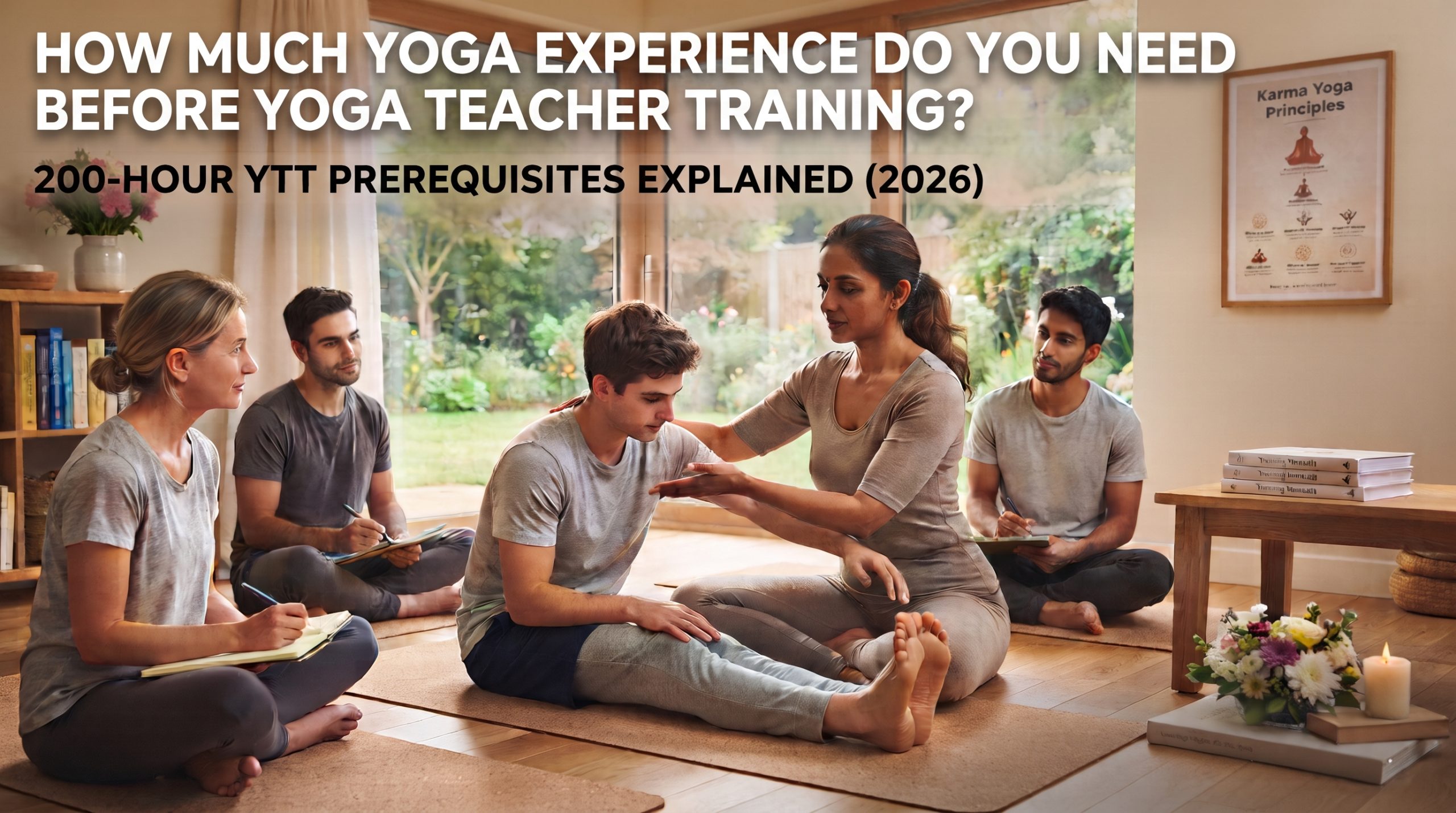
 How Much Yoga Experience Do You Need Before Yoga Teacher Training? 200-Hour YTT Prerequisites Explained (2026)
You love yoga. You practice a few times a week. And lately, you can’t stop thinking about teaching it. But one question keeps holding you back: do you have enough experience to sign up for a 200-hour yoga teacher training?
It’s a fair question. Some schools list zero prerequisites. Others ask for a year or more of steady practice. The confusion isn’t your fault. The requirements genuinely vary, because the main governing body for the industry leaves the decision up to individual schools.
This guide breaks down exactly what you need before enrolling in a 200-hour YTT in 2026. You’ll learn what Yoga Alliance actually requires, what most reputable schools recommend, and how to know if you’re truly ready. By the end, you’ll have a clear answer instead of a guess.
The Short Answer: What Yoga Alliance Actually Requires
Here’s the surprising part. Yoga Alliance, the organization that registers yoga schools and teachers, does not require any minimum amount of personal practice before you enroll in a 200-hour program. To register as an RYT-200, you simply need to complete a 200-hour training at a school registered with Yoga Alliance. There’s no mandated number of practice hours, no minimum years of experience, and no teaching requirement at all.
This surprises a lot of people. Many assume a governing body sets strict entry rules, the way a nursing program requires prerequisite coursework. Yoga Alliance works differently. It’s a registry, not a licensing board. It doesn’t certify individual teachers or vet each student’s readiness. It accredits schools, and it trusts those schools to set their own admission standards.
That single fact explains almost all of the confusion around this topic. When someone tells you “you need at least a year of practice” and someone else says “no experience necessary,” they’re both right. They’re just describing different schools’ policies, not a universal rule. So the real question isn’t “what does the industry require.” It’s “what does the specific school I’m considering require, and what do I actually need to succeed once I’m there.”
It’s also worth clearing up a common mix-up. Some people confuse RYT-200 with the E-RYT 200 credential, which does require two years and 1,000 hours of teaching experience. That requirement applies after you’ve already completed training and started teaching. It has nothing to do with getting into a 200-hour program in the first place.
Why Most Schools Set Their Own Experience Requirements
If Yoga Alliance doesn’t require prior experience, why do so many training programs ask for it anyway? The answer comes down to practical teaching realities, not bureaucracy.
A 200-hour training moves fast. Yoga Alliance requires schools to cover a defined core curriculum spanning techniques and practice, teaching methodology, anatomy and physiology, and yoga philosophy and ethics, all within 200 classroom hours. That’s a lot of ground to cover in a matter of weeks or months, all while practicing multiple times a week. Instructors need students who can follow along without stopping to learn what “downward dog” means for the first time. Schools that skip a practice prerequisite often build in extra foundational content to compensate, which can mean less time on the teaching skills you actually signed up for.
There’s also a safety consideration. Yoga teacher trainings involve significantly more time on the mat than a typical weekly class. Backbends, inversions, and long holds appear regularly, sometimes multiple times a day. A body that hasn’t built any tolerance for that volume is more likely to get injured, which helps nobody, least of all a future teacher trying to model safe practice.
Finally, schools want graduates who understand yoga from the inside before they start explaining it to others. Teaching an art form you’ve barely experienced tends to produce shallow instruction. Most program directors would rather turn away an unprepared applicant than certify a teacher who can’t yet speak to their own practice with any depth. If you’re comparing programs, our 200-hour YTT prerequisites page outlines exactly what we ask of incoming students and why, and our lead trainers are always happy to talk through whether your current practice level is a good fit before you apply.
The Six-Month Benchmark: Is It Enough?
Six months of consistent practice is probably the most common minimum you’ll see listed on program applications. It’s a reasonable middle ground, and it’s worth understanding what that timeframe typically builds.
After six months of practicing two to three times a week, most students have a working vocabulary of common poses and can follow a teacher’s verbal cues without needing visual demonstration for everything. They’ve likely experimented with more than one class style, whether that’s vinyasa, hatha, or restorative. They understand what it feels like to breathe intentionally during movement, and they’ve probably experienced at least a few plateaus and small breakthroughs in flexibility or strength.
That foundation matters, because a 200-hour training isn’t structured like a beginner class. You’ll be asked to hold poses longer than usual so trainers can observe alignment. You’ll practice teaching sequences to classmates, which requires enough familiarity with the poses that you’re not mentally translating instructions in real time. Six months generally gets a student to that baseline, though it depends heavily on how often and how intentionally someone practiced during that window.
Where six months tends to fall short is depth of embodiment. Many students at this stage still rely on cues rather than internal sensation to find alignment. That’s completely normal, and a good training program will continue developing that skill. But if your six months included only occasional, inconsistent classes rather than a regular rhythm, it’s worth being honest with yourself about whether you’re at that baseline or still approaching it.
 When One to Two Years of Practice Makes More Sense
Some students benefit from a longer runway before training, and it’s worth considering whether you’re one of them.
If you’re coming to yoga from a completely different fitness background, such as running or weightlifting, your body may move well in general but lack the specific mobility and body awareness yoga asks for. A longer practice period gives connective tissue, joint mobility, and proprioception time to adapt. Rushing this stage doesn’t just slow your progress; it raises injury risk once training intensifies the workload.
The style of training you’re pursuing also matters. Physically demanding traditions like Ashtanga or Power Vinyasa ask more of the body than a gentle Hatha or Yin-focused program. If you’re eyeing a rigorous style, extra time building strength and flexibility before training pays off during the program itself, when you won’t have much bandwidth left for playing catch-up physically while also absorbing new material. Our guide to different yoga styles can help you figure out which approach fits your body and goals before you commit to a program.
There’s also an emotional and philosophical dimension. Yoga teacher training often surfaces deeper self-reflection than a typical class, touching on ethics, history, and personal growth. Students who’ve spent a year or more sitting with those questions on their own mat tend to arrive with more clarity about why they want to teach, not just that they want to. Neither timeline is objectively better. The right one depends on your starting point, your goals, and the intensity of the program you’re choosing.
Physical Readiness vs. Time on the Mat: What Actually Matters
Here’s an important distinction: the number of months you’ve practiced matters less than what your practice actually looks like during that time. Two people who’ve each practiced for eight months can arrive at training with very different levels of readiness.
Consistency counts more than duration. Someone who practiced twice a week for six months has typically built more functional strength and body awareness than someone who practiced sporadically for a year. Schools that list a minimum timeframe are really using it as a rough proxy for consistency, not a magic number with special significance.
Physical readiness also includes basic joint and spinal health. Certain poses common in YTT programs, such as deep backbends, wrist-bearing arm balances, and seated forward folds, put real demand on the body. According to the National Center for Complementary and Integrative Health (NCCIH), part of the National Institutes of Health, yoga is generally considered safe for healthy people when practiced appropriately, though injuries can still occur, just as with any physical activity. NCCIH also notes that learning yoga on your own, without supervision, has been linked to a higher risk of injury — one more reason a period of guided, supervised practice before training is so valuable.
Beyond the physical, readiness includes stamina for a demanding schedule. Training days often run several hours long and combine practice, lecture, and practice-teaching. If sitting through a 90-minute class already leaves you drained, a full training day will be a significant jump. Building up tolerance for longer sessions before you start is one of the most underrated ways to prepare.
Mental stamina matters just as much as physical stamina. A single day of training can involve absorbing new anatomical terms, practicing a physically demanding sequence, and then standing up to teach that same sequence to classmates, sometimes all before lunch. Students who’ve never had to hold focus for that long in a physical setting often find the mental fatigue more surprising than the physical soreness.
Can Total Beginners Enroll in a 200-Hour YTT?
Technically, yes. Since Yoga Alliance doesn’t mandate prior experience, nothing stops a school from accepting someone brand new to yoga. Some programs are designed specifically with this in mind, often building extra foundational weeks into the schedule to bring beginners up to speed before the core curriculum begins.
That said, most experienced trainers would advise against it, and it’s worth understanding why before you consider this path. A total beginner enters training simultaneously learning what a pose is, how it should feel, how to modify it for different bodies, and how to cue it for someone else. That’s a lot of layers stacked on top of each other, and something usually gets shortchanged. Most often, it’s depth of personal understanding — the very thing that makes a teacher’s instruction feel grounded rather than recited from a manual.
There are exceptions worth knowing about. A small number of programs run an extended format, sometimes six to twelve months, specifically to accommodate newer students by weaving foundational practice into the early curriculum. These programs cost more and take longer, but they can work well for someone who’s certain about teaching yoga but hasn’t had years to build a personal practice first.
If you’re a genuine beginner and drawn to teaching, the more common and generally more successful path is to spend three to six months building a consistent home and studio practice first, then enroll once you have a working foundation. Check out our FAQ page for answers to common questions from students weighing this exact decision.
How to Know You’re Ready: A Self-Assessment
Rather than fixating on a specific number of months, ask yourself a few honest questions.
Can you attend and sustain a full class without needing frequent breaks or modifications for basic conditioning reasons? Do you recognize the names of common poses across at least one or two styles, and can you generally find your way into them without a teacher demonstrating each one? Have you experienced what it’s like to move through a plateau in your practice, where progress feels stalled but you kept showing up anyway? That kind of persistence tends to predict how someone handles the harder stretches of a training program.
Consider your schedule and stamina too. Have you sat through, or could you realistically sustain, several hours of combined movement and learning in a single day? Training days are longer and more demanding than a typical class, and stamina matters as much as flexibility.
Finally, ask why you want to teach. Students who can articulate a clear, personal reason, beyond “I love yoga,” tend to get more out of training and go on to teach with more confidence. If you’re still working out why yoga matters to you, spending more time in your own practice before training will likely serve you better than rushing into a program.
If you answered yes to most of these, you’re probably ready, regardless of the exact number of months on the calendar. If several gave you pause, that’s useful information too. It doesn’t mean teaching isn’t for you. It just means a bit more time on the mat first will make the training itself far more valuable.
What Happens If You Start Too Soon
It’s worth being honest about the downside of jumping in before you’re ready, because the consequences are real, even if they’re rarely talked about.
The most immediate risk is physical. Training intensifies your practice volume quickly, and a body without a base level of conditioning is more prone to strains, particularly in the wrists, lower back, and hamstrings. An injury early in training can sideline you for the rest of the program, turning an investment of thousands of dollars into a costly setback. Our guide to preventing common yoga injuries covers the specific areas trainees tend to strain and how to protect them before training even starts.
There’s also a knowledge gap that’s harder to fix mid-program. If your classmates already know pose names, basic anatomy terms, and common sequencing patterns, and you’re learning them for the first time, you’ll likely spend your energy just keeping up rather than deepening your understanding. That often shows up later as a teacher who can demonstrate a sequence but struggles to explain the reasoning behind it.
Finally, there’s the financial and emotional cost of a mismatch. Most 200-hour programs run between $2,000 and $5,000, along with a serious time commitment. Enrolling before you’re ready sometimes means finishing the program feeling underprepared to teach, or worse, dropping out partway through. Waiting a few extra months to build your foundation is almost always cheaper, in every sense, than starting over.
 Building Your Practice Before Training: A Practical Plan
If you’ve decided you want more time before enrolling, here’s a realistic approach to get there.
Aim for three to four classes a week, ideally mixing styles so you experience both dynamic movement and stillness-focused practice. Variety builds a broader vocabulary of poses and cueing language, which pays off once training begins. If your budget allows, work with the same teacher regularly rather than hopping between studios. A teacher who knows your body can give you more specific, useful feedback over time than a rotating cast of instructors.
Start paying attention to alignment cues rather than just following along. When a teacher says to root through the outer edge of the foot or draw the shoulder blades down the back, notice what that actually changes in your body. This habit of translating verbal instruction into physical sensation is exactly what you’ll need during practice-teaching later.
Consider keeping a simple practice journal. Note which poses challenge you, which ones feel easy, and how your body responds to different class lengths and intensities. This record becomes genuinely useful once you start designing your own sequences in training, because you’ll already understand how your body reacts to different structures.
Finally, read a little philosophy alongside your physical practice. Even a basic overview of the Yoga Sutras or the eight limbs gives you a head start on the philosophy component of most trainings, which surprises many students with how much reading and discussion it involves.
Choosing a 200-Hour YTT That Matches Your Experience Level
Once you’ve built a solid foundation, or decided you’re ready to start where you are, the next step is finding a program that fits.
Look closely at each school’s stated prerequisites, and take them seriously. A program that requires six months of practice is signaling something about its pace and intensity. A program with no stated prerequisite may be more beginner-friendly, but ask directly how they support newer students so no one falls behind. Reputable schools are usually happy to walk you through their approach; if a school is vague or dismissive about this question, treat that as a signal.
Pay attention to format as well. Our breakdown of online versus in-person training covers this in more depth, but as a general rule, in-person training offers more hands-on correction, which benefits students earlier in their practice. Fully online programs can work well, but they place more responsibility on you to self-assess alignment and safety, which is easier once you already have some practice under your belt. The fitness education organization ACE offers a helpful, independent rundown of questions to ask any program before you commit, regardless of format.
Finally, talk to alumni if you can. Ask what surprised them, whether they felt prepared going in, and what they wish they’d done differently beforehand. Real feedback from people who’ve completed the exact program you’re considering is more useful than any prerequisite list. When you’re ready to explore a program built around clear, realistic prerequisites and genuine support for every experience level, our 200-hour YTT page is a good place to start.
Final Thoughts: How Much Experience You Really Need
So, how much yoga experience do you need before yoga teacher training? The 200-hour YTT prerequisites explained above come down to this: Yoga Alliance sets no minimum, but most reputable schools recommend somewhere between six months and two years of consistent personal practice, depending on the training’s intensity and your own starting point.
The number that matters most isn’t a specific month count. It’s whether you can follow a class confidently, sustain a demanding schedule, and articulate why you want to teach. Build that foundation first, choose a program that matches your experience level, and you’ll walk into training ready to get the most out of it, rather than just trying to keep up.
If you’re ready to take the next step, explore our 200-hour YTT program to see how we support students at every stage of their practice, from six-month beginners to seasoned yogis ready to teach.