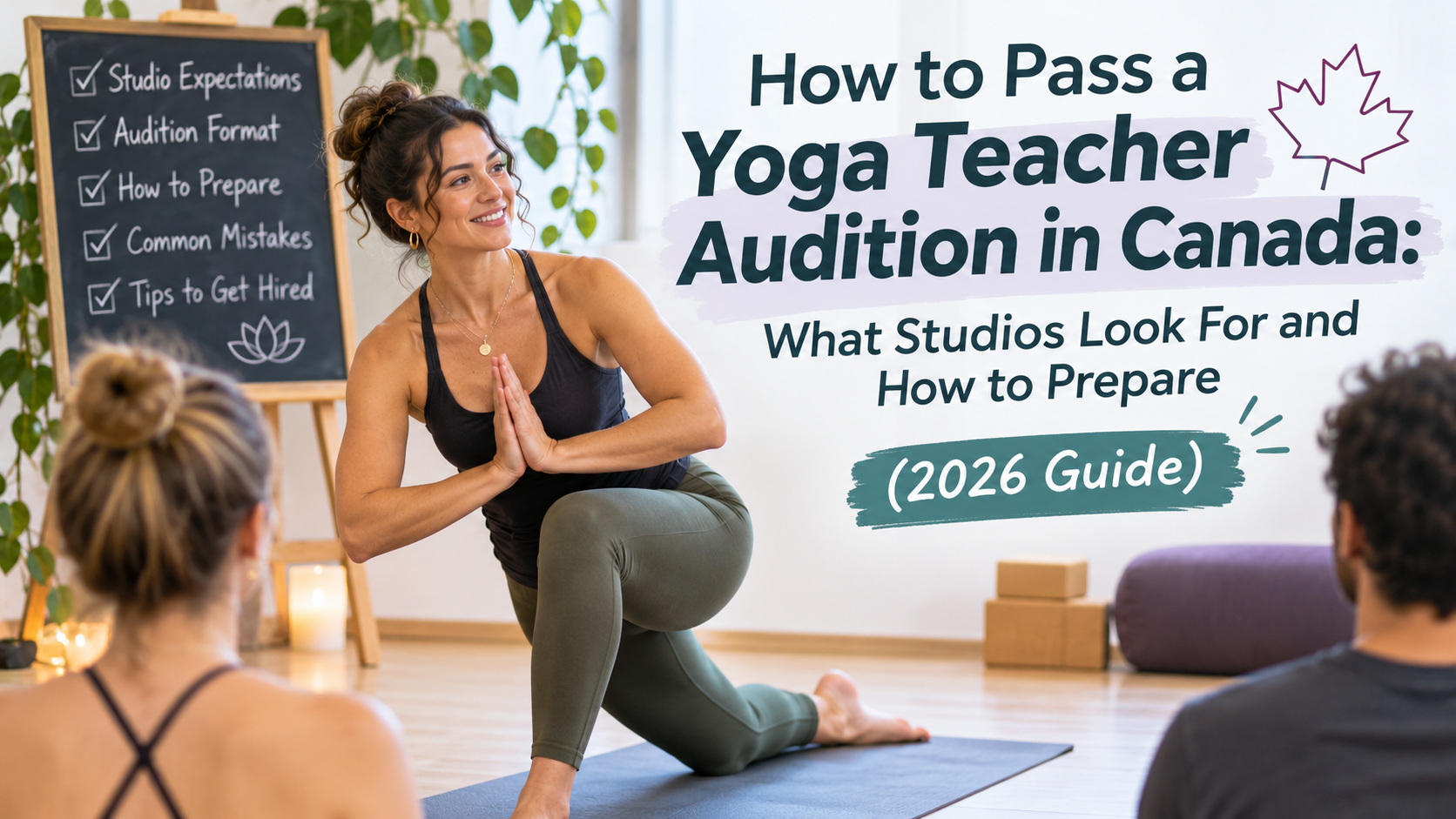
 How to Pass a Yoga Teacher Audition in Canada: What Studios Look For and How to Prepare (2026 Guide)
Introduction
You finished your training. You love teaching. Now a studio has invited you to audition, and your stomach is in knots.
That reaction is normal. An audition feels personal. A studio owner or lead teacher watches you lead a class, then decides whether you fit their space. Many new teachers also assume the audition tests flexibility or advanced poses. It does not.
This guide, How to Pass a Yoga Teacher Audition in Canada: What Studios Look For and How to Prepare (2026 Guide), explains how studios actually evaluate new teachers. You will learn what happens in the room, which skills matter most, and how to build a simple preparation plan. You will also learn about Canadian realities such as insurance, bilingual classrooms, and self-employment.
The advice here comes from common studio hiring practice and from published training standards. Every studio runs auditions differently. Treat this guide as a framework, then ask each studio what its process involves.
What a Yoga Teacher Audition Looks Like in Canada
Auditions vary, but most follow a familiar pattern. Knowing the pattern removes much of the fear.
The common formats
Most studios use one of these formats:
- A short demo class. You teach 15 to 30 minutes of a class to the manager and sometimes a few staff members.
- A full class. You teach a complete 60-minute class to real students, often on a trial or community slot.
- A group audition. Several candidates teach in turn while the studio watches.
- An interview plus a demo. You talk about your training and goals, then teach a short segment.
- A video audition. Some studios, especially those with online classes, ask for a recorded sample.
Who watches you
The people in the room usually include the studio owner, a manager, or a senior teacher. They may also watch students. Student comfort matters because the studio’s income depends on people returning.
What the studio wants to learn
An audition answers practical questions. Can you teach a safe class? Can students follow you? Do you fit the studio’s style? Will you show up on time, communicate well, and represent the brand?
Why nerves are expected
Studio owners know new teachers feel nervous. They are not looking for a flawless performance. They want to see how you recover when you lose your place, how you respond to a student who needs help, and whether you stay calm.
Ask three questions before your audition:
- How long will I teach?
- What style and level does the studio offer?
- Will I teach studio members or other candidates?
The answers shape your preparation. A 20-minute vinyasa demo needs a different plan than a 60-minute restorative class.
What Studios Look For in a New Teacher
Studios hire people, not just certificates. Most hiring managers weigh several qualities at once. Here are the ones that matter most.
Safety and Sound Instruction
Safety comes first. A studio carries legal and reputational risk when a teacher gives unsafe cues. You show safety by offering options, avoiding risky transitions for beginners, and warming the body before deep poses.
Explain how to enter and exit each pose. Offer a simpler version of every challenging shape. Avoid forcing students into extreme ranges of motion. Never push or adjust anyone without clear consent.
Clear, Confident Cueing
Students cannot see you while they hold a pose with their eyes closed or their head down. They rely on your words. Studios listen closely for cues that are short, specific, and in the right order.
A strong cue names the body part, the action, and the direction. “Press your front foot into the mat and lift your chest” works better than “Get into a good Warrior.” Good teachers also pause. Silence gives students time to move.
Thoughtful Sequencing
A class should build logically. It warms up, works toward a peak or theme, then cools down. Studios want to see that you understand this arc.
Sequencing also shows you respect your students. Random poses suggest a teacher who copied a playlist of moves. A planned flow suggests a teacher who understands how bodies prepare for effort.
Warmth and Presence
Studios look for teachers students want to return to. That does not require a big personality. It requires attention. Learn names if you can. Make eye contact. Move around the room. Notice when someone struggles.
Professionalism and Reliability
Studios also assess how you behave outside the poses. Do you arrive early? Do you answer emails promptly? Do you dress appropriately for the studio’s culture? Do you accept feedback without defensiveness?
One manager’s experience will not match another’s. But reliability consistently ranks high when studios decide whom to keep on the schedule. A moderately skilled teacher who never cancels often beats a brilliant teacher who does.
A Clear Fit With the Studio
Each studio has its own identity. A hot vinyasa studio hires differently than a gentle community studio. Research the schedule, the teacher bios, and the social media tone. Then decide where you fit. If you teach Yin and the studio only offers power yoga, you may need to pitch a new class instead.
Do You Need Credentials to Teach Yoga in Canada?
New teachers often ask this question first. The short answer is that Canada does not require a government licence to teach yoga. As of 2026, yoga instruction is not a regulated profession here.
That does not mean credentials do not matter. Most studios expect a completed teacher training from a recognized school. Many also expect insurance, which insurers usually tie to a credential.
The 200-hour standard
The 200-hour training is the most common entry point. Yoga Alliance publishes standards for schools that offer a 200-hour program. Those standards describe required topics such as technique, teaching methodology, anatomy, philosophy, and practice teaching.
After completing a program with a registered school, a graduate can apply for the RYT 200 designation. Yoga Alliance’s credential standards explain this process. The same document describes the E-RYT 200 level. That designation requires at least two years of teaching and 1,000 teaching hours after your training.
Different organizations exist
Several organizations certify schools. Yoga Alliance is the best-known, but Yoga Alliance International is a separate organization with its own standards. Some studios have a preference. Others care more about the quality of your training than the name on the certificate.
Ask the studio what it accepts before you apply. This avoids wasted effort.
Specialty training helps
A general 200-hour certificate opens the door. Specialty training can set you apart. Studios often need teachers for restorative, prenatal, kids, or chair classes. If you hold extra training, mention it. You can explore options such as Restorative Yoga teacher training online if you want to grow into a niche.
Bring your documents
Carry a copy of your certificate to the audition. Bring proof of insurance if you have it. Also bring a CPR or first aid certificate if you hold one. Yoga Alliance suggests CPR and first aid training for all registered teachers. Many Canadian studios also like to see current first aid certification, though requirements vary.
 The Technical Skills You Should Be Ready to Show
You do not need to perform advanced acrobatics. You do need to show reliable command of the basics. Studios use these fundamentals to judge whether a teacher is ready.
Master the foundational poses
Know the common poses well enough to teach them without notes. Practise explaining how to set up and exit each pose. Pay special attention to poses where beginners often injure themselves or lose alignment.
Start with the building blocks. Review Mountain Pose, which underlies most standing alignment. Then work through Downward Facing Dog and Warrior I. These poses appear in nearly every vinyasa class. If you can cue them clearly, you can cue most of a basic class.
Know your anatomy
You do not need to recite muscle names. You do need to understand how joints move and where common problems arise. Know the basics of the spine, shoulders, hips, and knees. Know which poses commonly stress the wrists or lower back. Know when to suggest a modification.
Use Sanskrit with care
Some studios like Sanskrit names. Others prefer plain English. If you use Sanskrit, pronounce it correctly and give the English alongside it. Keep a quick reference of terms nearby, such as the yoga terms glossary.
Include breathwork
Breath guides the pace of the class. Many studios appreciate a short breathing practice at the start or end. Practise leading Ujjayi breath or a simple four-part breath. Keep your instructions simple and your pace slow. Always give students permission to breathe naturally if a technique feels uncomfortable.
Offer options in every phase
Every class has students at different levels. Show that you see this. Offer a gentler option, a standard option, and a challenging option for key poses. This tells the studio you can teach a mixed-level room.
Practise time management
Many new teachers run out of time or finish early. Rehearse with a timer. Build in a few extra minutes of flexibility. A class that ends on time feels professional.
Voice, Presence, and Teaching Style
Technical knowledge matters. But students remember how a class felt. Voice and presence shape that feeling.
Find a natural speaking voice
Many new teachers adopt a soft, slow, “yoga voice” that sounds forced. Studios notice. Speak the way you speak in a calm conversation. Aim for steady volume and relaxed pacing. Project so the back row can hear you without shouting.
Use fewer words, with more purpose
Over-talking is a common mistake. When you speak constantly, students cannot feel their own bodies. Give a cue, then pause. Let silence do some of the work.
Cue what you see
Great teachers watch the room and respond. If three students let their knees collapse inward, say so. Offer a correction to the whole room. Use phrases like “if it feels right for you” to keep the tone inviting.
Respect consent and boundaries
Hands-on adjustments carry risk. Many studios now require teachers to ask permission before touching a student. Some discourage touch altogether. At an audition, verbal cues are the safer choice unless the studio tells you otherwise. If you do offer an assist, ask first and keep it simple.
Be inclusive
Use language that welcomes all bodies. Avoid assumptions about age, ability, or gender. Avoid comments on weight or appearance. Studios want teachers who make newcomers feel safe.
Show your own voice
You do not need to copy your favourite teacher. Share a theme that matters to you, a short reading, or a simple intention. Authenticity stands out. Just keep it brief and relevant. A long philosophical talk can bore students who came to move.
Handle mistakes gracefully
You will likely forget a pose or mix up left and right. That happens to experienced teachers too. Pause, laugh lightly if appropriate, and correct yourself. Studios often respect composure more than perfection.
A Six-Week Preparation Plan
A short, structured plan beats last-minute cramming. If you have six weeks, use this schedule. If you have less time, compress the steps.
Weeks 1 and 2: Build your foundation
Choose the class you plan to teach. Match it to the studio’s style. Write a full class plan with timings. Include a warm-up, a main sequence, a cool-down, and a final rest.
Practise the sequence yourself. Notice where the transitions feel awkward. Adjust the order until the flow feels natural. Record yourself teaching alone, then watch the video. You will spot habits you did not know you had.
Weeks 3 and 4: Teach real people
Find friends, family, or classmates who will take a practice class. Ask for honest feedback on clarity, pace, and comfort. Ask specific questions. Did my cues make sense? Did I rush? Was anything confusing?
Teach at least three times. Each run will feel smoother. Try teaching the sequence from memory, then with a one-page cheat sheet.
Week 5: Refine and simplify
Cut anything that feels unnecessary. A tight, well-taught class beats a crowded one. Rehearse your opening and your closing words. Those are the moments students remember.
Prepare answers to likely interview questions:
- Why do you want to teach here?
- What style do you teach?
- How do you handle a student with an injury?
- What is your availability?
- Where do you see yourself in a year?
Week 6: Final polish
Run a full dress rehearsal. Use the same clothes, the same music, and the same timer you plan to use. Pack your bag the night before. Visit the studio as a student if you can. Practising in the space helps you understand the acoustics, the room size, and the culture.
If you want to deepen your knowledge during this stretch, browse the Yoga Careers articles on the Karma Yoga blog. They cover many practical topics for new teachers.
What to Do on Audition Day
Preparation helps most when you stay calm on the day. These steps keep you steady.
Arrive early
Plan to arrive 20 to 30 minutes before your slot. Use the extra time to check the space, find the light switches, test the sound system, and set up your mat. Early arrival also signals reliability.
Dress for the studio
Wear clean, comfortable clothing that lets you demonstrate poses. Avoid anything that shifts or requires constant adjustment. Match the studio’s style without being overly flashy.
Bring what you need
Pack a copy of your class plan, a timer or watch, a water bottle, and your credentials. Bring your own music only if the studio has asked for it. Otherwise, ask whether you should use their system or teach in silence.
Open with confidence
Introduce yourself briefly. Welcome the group. Give a short overview of what you will teach. Then begin. A clear opening sets the tone and calms your own nerves.
Breathe and slow down
Nerves usually make teachers talk faster. Take a deep breath before each new sequence. Slow your speech slightly. If you lose your place, glance at your notes. No one will mind.
Watch the room
Look at your students while you teach. Adjust your pacing if people look lost. Keep your focus outside yourself. This also helps you forget your own nerves.
Close well
Finish with a clear final rest and a closing phrase. Thank the group. Stay a few minutes afterward for questions. Studio owners often use that time to assess how you handle conversation.
Ask your own questions
An audition goes both ways. Ask about class sizes, pay structure, substitution policies, and expectations around promotion. Asking thoughtful questions shows maturity. It also helps you decide whether the studio suits you.
 Common Mistakes That Cost Candidates the Job
Most auditions fail for ordinary reasons, not dramatic ones. Here are the mistakes studio managers mention most often.
Overloading the class. New teachers often try to prove themselves with complex flows. Keep it simple. Studios want a clear, safe class.
Talking too much or too little. Constant chatter overwhelms students. Total silence leaves them lost. Aim for balance.
Ignoring the studio’s style. A fast, athletic class at a gentle studio signals poor research. Study the schedule first.
Skipping modifications. If you never offer an option, you will seem inexperienced. Always include at least one.
Copying another teacher. Students and managers can spot imitation. Develop your own voice.
Running over or under time. Time awareness shows professionalism. Practise with a clock.
Neglecting the interview. Some candidates prepare only the demo. Then they stumble when asked about availability or teaching goals. Prepare answers ahead of time.
Appearing inflexible. Studios work with teams. Show that you accept feedback. If the manager suggests a change, say thank you and ask a follow-up question.
Overstating experience. Be honest about your background. Studios verify credentials. Honesty builds trust, and trust is what gets you hired.
Canadian Realities: Insurance, Language, and Self-Employment
Teaching in Canada brings a few practical considerations. Understanding them early makes you a stronger candidate.
Liability insurance
Many studios ask teachers to carry their own liability insurance. Some provide coverage under the studio’s policy. Others require both. Ask early. Insurance providers that serve fitness professionals often offer plans for yoga teachers, and rates vary by coverage and region.
Language expectations
Canada has two official languages, and local needs differ. In Quebec, many studios teach in French, and some teach in both languages. If you speak French, say so. In other provinces, studios may serve multilingual communities and value teachers who can offer cues in more than one language.
Contractor status and taxes
Most yoga teachers in Canada work as independent contractors, not employees. That means you are usually responsible for tracking your income, filing your taxes, and paying your own contributions. If you charge for taxable services, you may also need to register for GST/HST once your sales pass a threshold. The Canada Revenue Agency explains the small supplier rule for businesses with $30,000 or less in taxable sales. Check the current rules for your situation, and consider speaking with an accountant.
Seasonal and regional demand
Class demand shifts with the seasons. Many studios see strong enrolment in January and September. Summer can slow down. Rural communities may have fewer studios but also fewer teachers. Urban centres offer more jobs and more competition. Think about where your style fits.
Build multiple income streams
Many Canadian teachers combine studio classes with private sessions, corporate classes, online teaching, or workshops. A diversified approach protects you when one source slows. Over time, you can add specialty skills to widen your options. Some teachers move on to a 300-hour yoga teacher training after gaining classroom experience.
After the Audition: Follow-Up and Next Steps
The audition does not end when the class does. What you do afterward still counts.
Send a thank-you message
Within 24 hours, send a brief note. Thank the studio for the opportunity. Mention one specific thing you enjoyed. Keep it short and sincere. This small step makes you memorable.
Ask for feedback
If you do not get the job, ask what you could improve. Many managers will share one or two helpful points. Take notes and apply them. A polite request often leads to a future invitation.
Offer to substitute
Many studios fill gaps through substitute teaching. If the studio has no regular slot, ask to join the substitute list. Subbing lets you build trust and show your reliability. Regular subs often become regular teachers.
Keep practising and learning
Continue teaching wherever you can. Community classes, friends, and online sessions all build skill. Read, study, and attend workshops. The more you teach, the less the audition will matter. Browse The Insider, the Karma Yoga blog, for ongoing ideas on teaching and professional growth.
Stay patient
Hiring decisions can take days or weeks. Studios often wait for a class slot to open. Silence does not always mean rejection. Follow up once after a reasonable time. Then move on to other opportunities while you wait.
Conclusion
An audition is a short window into your teaching. It is not a verdict on your worth. Studios want teachers who are safe, clear, warm, and reliable. You can build all four with preparation and practice.
To recap How to Pass a Yoga Teacher Audition in Canada: What Studios Look For and How to Prepare (2026 Guide), the main takeaway is simple. Teach a clear, safe, well-timed class in your own voice, and show you are professional and easy to work with. Research the studio. Practise with real people. Understand the Canadian basics of insurance, language, and self-employment. Then follow up with care.
If you are ready to become a yoga teacher, check out our 200-hour yoga teacher training online. Karma Yoga offers more than 30 Yoga Alliance International certified programs across Canada and worldwide. Our team can answer your questions through our contact page.